.png)

Banff to Jasper Private Tour: Scenic Stops Explained
The Ultimate Guide to Canada's Most Iconic Road Trip
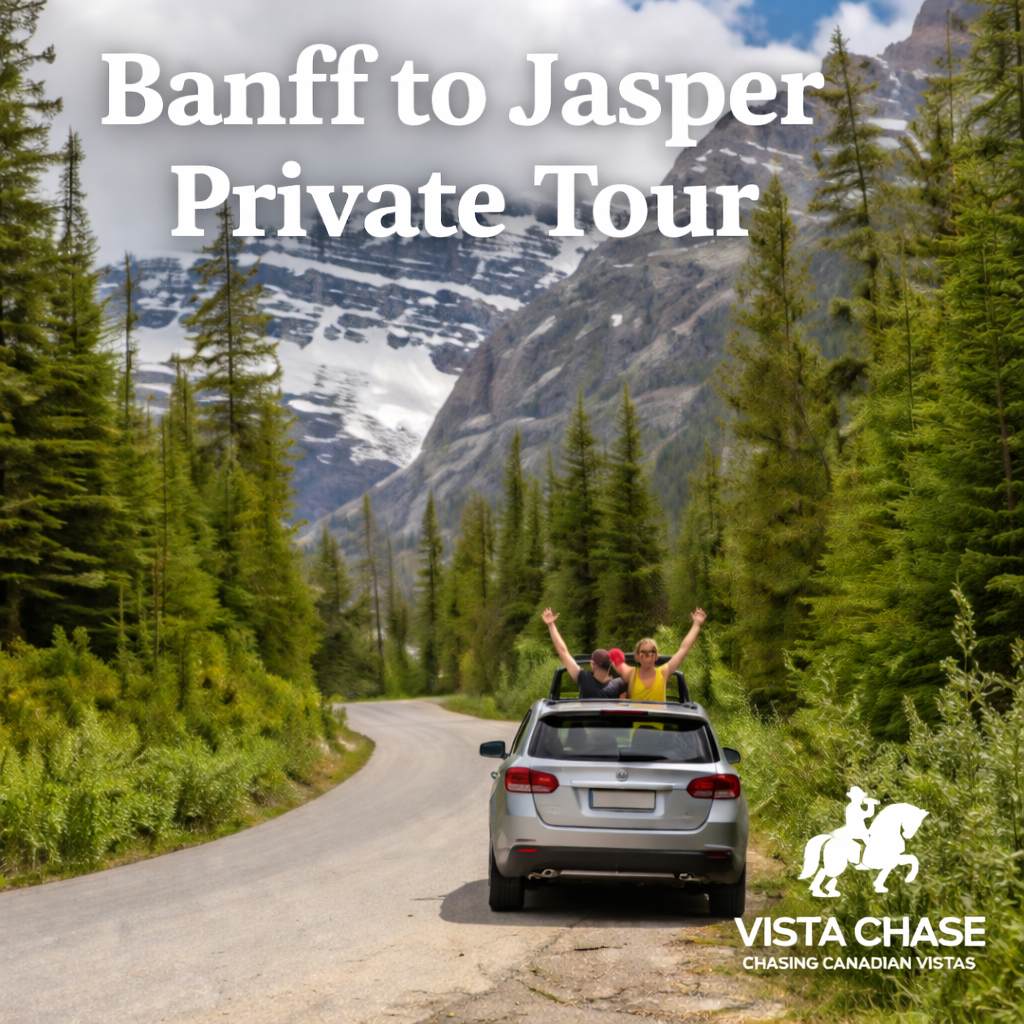
The drive from Banff to Jasper along the Icefields Parkway is widely considered one of the greatest road trips on the planet. Stretching 232 kilometres through the heart of the Canadian Rockies, this legendary route connects two of Canada's most celebrated national parks: Banff National Park and Jasper National Park. Whether you are a first-time visitor or a seasoned traveller returning for more, a private tour from Banff to Jasper transforms a beautiful drive into a deeply personal, expertly guided experience.If you're planning your trip to the Canadian Rockies, explore more travel experiences on VistaChase homepage
This guide breaks down every significant scenic stop along the Banff to Jasper private tour route, explains why each location matters, and tells you exactly what to expect. It is written for travellers who want more than a surface-level look at the Rockies. It is for people who want to understand what they are seeing, feel connected to the landscape, and make the most of every kilometre.
Why Choose a Private Tour from Banff to Jasper?
Before diving into the scenic stops, it is worth understanding why a private tour is the superior way to experience this route. The Icefields Parkway is not a highway you should rush. It demands time, presence, and knowledge. A private tour delivers all three.
1. Personalised Pace and Flexibility
With a private tour, you stop when you want, linger as long as you like, and skip what does not interest you. Unlike group bus tours that operate on rigid timetables, a private guide adjusts the day to your preferences. Want to spend an extra 45 minutes at Peyto Lake? Done. Prefer to skip Athabasca Falls and spend that time at the Columbia Icefield? No problem.
2. Expert Local Knowledge
A knowledgeable private guide does not just point at mountains. They explain glacial geology, share the names of peaks in Stoney Nakoda, Blackfoot, and Cree languages, tell stories of early explorers, and help you understand why the Columbia Icefield is considered the hydrological apex of North America. That context transforms scenery into meaning.
3. Wildlife Spotting Advantage
The Canadian Rockies are home to grizzly bears, black bears, elk, bighorn sheep, mountain goats, wolves, moose, and coyotes. Private guides know the best wildlife corridors, the right times of day, and the seasonal behaviour patterns of local animals. You will see far more wildlife on a private tour than driving alone.
4. Photography Opportunities
Private tours accommodate photographers at every level. Guides know when light hits Peyto Lake perfectly, which angle gives the best reflection at Herbert Lake, and how to position yourself at Athabasca Glacier for a dramatic composition. Your guide will wait while you get the shot.
5. Comfort and Safety
Driving the Icefields Parkway in winter, or even during unpredictable summer weather, can be challenging for visitors unfamiliar with mountain driving. A private driver handles all navigation, road conditions, and parking logistics, allowing you to focus entirely on the experience.
If you're looking for an affordable and social way to explore, our shared tours in Banff offer small-group adventures covering top highlights in one day.
The Route: Banff to Jasper at a Glance
The Banff to Jasper private tour covers Highway 93, also known as the Icefields Parkway, from the town of Banff through Lake Louise, past Saskatchewan River Crossing, through the Columbia Icefield Discovery Centre, and into the town of Jasper. The one-way distance is approximately 232 kilometres. A private tour typically takes 8 to 12 hours depending on stops and season.
Starting Point: Town of Banff, Alberta
End Point: Town of Jasper, Alberta
Distance: 232 km (144 miles)
Estimated Duration: 8 to 12 hours with stops
Road: Highway 93 North (Icefields Parkway)
National Park Pass Required: Yes. Parks Canada pass covers both parks.
Best Seasons: May through October (some stops accessible year-round)
Scenic Stop 1: Bow Lake and Num-Ti-Jah Lodge
Distance from Banff: Approximately 86 km
Elevation: 1,920 metres (6,300 feet)
Why It Matters: One of the most photographed lakes in Canada
Bow Lake is the third-largest lake in Banff National Park and among the first major stops on the Icefields Parkway north of Lake Louise. Fed by the Bow Glacier, the lake displays a stunning turquoise colour caused by glacial rock flour suspended in the meltwater. The fine particles scatter sunlight in a way that makes the water appear almost impossibly vivid.
At the far end of the lake sits Num-Ti-Jah Lodge, a historic red-roofed outpost that has welcomed explorers and travellers since the 1920s. The lodge was established by legendary outfitter Jimmy Simpson, whose name still marks a nearby peak. It remains one of the most atmospheric places along the entire Parkway to stop for a coffee or meal.
Know more about Yoho National Park day tour.
What to Do at Bow Lake
Walk the short trail along the lake's edge to the fan delta at the inlet, where the colour of the water changes dramatically depending on the time of day. In morning light, the lake glows aquamarine. By midday, it shifts toward deep green-blue. Early October brings golden larches to the surrounding slopes, making this one of the most sought-after autumn photography destinations in all of Canada.
What Your Private Guide Will Explain
Your guide will explain the science behind glacial flour colouration, the geological history of the Waputik Icefield above the lake, and the cultural history of the Stoney Nakoda peoples who traversed this valley for thousands of years before European explorers arrived.
Planning a bigger Canada trip? Don’t miss our complete guide to the Calgary Stampede 2026 — the world’s greatest outdoor show and an unforgettable experience just a short drive from Banff.
Scenic Stop 2: Peyto Lake Viewpoint
Distance from Banff: Approximately 86 km (just past Bow Lake)
Elevation of Viewpoint: 2,069 metres (6,788 feet)
Why It Matters: The most iconic lake view in the Canadian Rockies
If there is one photograph that defines the Banff to Jasper route, it is the view from the Bow Summit viewpoint looking down at Peyto Lake. The lake sits in a deep glacially carved valley, and from the elevated viewpoint its distinctive shape, which many describe as resembling a wolf or dog running through the valley, is visible in full. The colour is an otherworldly electric blue-green, far more vivid than photographs suggest.
The lake was named after Bill Peyto, a colourful Banff guide and outfitter from the early 1900s known for his independent character and deep knowledge of the backcountry. It is pronounced PEE-toe, a point your private guide will make immediately so you are never caught mispronouncing it on the tour.
The Walk to the Viewpoint
From the parking area at Bow Summit, a well-maintained trail leads through subalpine forest approximately 1 kilometre to the main viewpoint platform. The walk takes about 20 to 30 minutes round trip. A longer trail continues to an upper viewpoint for an even more sweeping panorama. Private tours with clients who prefer less walking can access the closer viewpoint quickly, while more active groups can extend the hike.
Best Time to Visit
Morning visits offer the calmest air and best reflection potential on the lake surface. The viewpoint can become crowded between 10 am and 2 pm in peak summer. Private tours that depart Banff early have a significant advantage in accessing the viewpoint with far fewer people present.
Before visiting Moraine Lake, make sure to read our detailed guide on access rules and parking to avoid last-minute surprises.
Scenic Stop 3: Mistaya Canyon
Distance from Banff: Approximately 100 km
Trail Length: 500 metres one way
Why It Matters: A dramatic limestone canyon most visitors bypass
Mistaya Canyon is one of the most underappreciated stops on the entire Icefields Parkway. The canyon was carved by the Mistaya River cutting through soft limestone over thousands of years, creating a narrow, swirling gorge with sculpted potholes, arches, and sheer walls. The name Mistaya comes from the Cree word for grizzly bear.
The hike from the parking area to the canyon rim is flat, short, and accessible, making it ideal for all fitness levels. Standing at the edge of the canyon and looking down at the turquoise water churning through the narrow passage is a genuinely dramatic experience that many group tours skip entirely due to time constraints.
Why Your Private Guide Makes This Stop Essential
A private guide will explain how potholes form through a process called pothole erosion, where rocks become trapped and spin in whirlpools, slowly grinding perfect circular holes into the limestone floor. They will also point out the geological layers visible in the canyon walls, each representing hundreds of thousands of years of ancient seabed sediment.
Scenic Stop 4: Saskatchewan River Crossing
Distance from Banff: Approximately 121 km
Why It Matters: Historic crossroads, wildlife habitat, and access to Howse Pass
Saskatchewan River Crossing, often called simply the Crossing, sits at the confluence of the North Saskatchewan, Howse, and Mistaya rivers. It is the only service stop between Lake Louise and the Columbia Icefield, making it a practical necessity. But it is also historically and ecologically significant.
This valley is one of the most important wildlife corridors in the entire Rocky Mountain ecosystem. Wolves, elk, moose, and grizzly bears routinely move through the open floodplain surrounding the Crossing. Your private guide will scan the valley while you refuel or grab a snack, as wildlife sightings here are common.
Historical Significance
The North Saskatchewan River valley was a major travel route for Indigenous peoples for thousands of years and later for fur traders crossing the mountains. David Thompson, the legendary surveyor and fur trader, crossed through the Howse Pass just west of here in 1807, mapping the interior of North America. Your guide will help you see the landscape through historical eyes, not just as scenery but as a human story unfolding across centuries.
Scenic Stop 5: The Columbia Icefield
Distance from Banff: Approximately 132 km
Elevation: Approaching 2,000 metres (6,562 feet)
Why It Matters: The largest icefield in the Rocky Mountains and the hydrological apex of North America
The Columbia Icefield is the centrepiece of the entire Banff to Jasper route. Covering approximately 325 square kilometres, it is the largest accumulation of ice and snow south of the Arctic Circle in North America. From this single source, meltwater flows into three of Canada's great river systems, eventually reaching three different oceans: the Pacific, the Atlantic through Hudson Bay, and the Arctic.
The Athabasca Glacier, one of six outlet glaciers fed by the Columbia Icefield, reaches right down to the roadside, making it one of the most accessible glaciers in the world. A visit here is unlike any other stop on the tour.
The Columbia Icefield Discovery Centre
The Parks Canada and Pursuit-operated Discovery Centre sits directly across the highway from the glacier and offers orientation exhibits, dining, and ticket services for glacier experiences. Your private guide will walk you through the key exhibits explaining climate change's impact on the glacier, which has been retreating measurably for decades.
Walking on the Athabasca Glacier
Two primary experiences allow visitors to step onto the glacier. The first is the Ice Explorer, a massive all-terrain vehicle that drives directly onto the glacier ice. The second is the Glacier Skywalk, a cliff-edge glass-floored walkway suspended above the Sunwapta Valley. Private tour clients can add either or both of these experiences. Your guide will advise based on your interests, mobility, and available time.
What Your Private Guide Explains Here
The glaciological science, the retreat markers that document exactly how far the glacier has pulled back in each decade since the early 1900s, the concept of a hydrological apex and why this location is genuinely unlike anywhere else on Earth, and the projected timeline for the icefield under current climate trajectories. This is one of the most educational stops of the entire journey.
Scenic Stop 6: Sunwapta Falls
Distance from Banff: Approximately 175 km
Trail Length: Short walk, under 10 minutes
Why It Matters: Dramatic canyon waterfall with easy access
Sunwapta Falls is a two-tiered waterfall on the Sunwapta River, carved into a narrow limestone canyon. The upper falls drop approximately 18 metres into a foaming pool below, then continue through a gorge to a lower falls visible from a secondary viewpoint downstream. The sound and mist of the falls is immediately striking, and the viewing platform above the main falls is excellent.
Sunwapta means turbulent water in Stoney Nakoda, a name that becomes instantly clear when you see the roaring cascade. The falls are most powerful in June and early July when glacial meltwater is at its peak.
Upper and Lower Falls
Most visitors only see the upper falls. Private tours that include the short additional walk to the lower falls reward clients with a perspective that most people miss entirely. The lower falls are accessed by a short trail that branches off just after the bridge, offering a view up into the gorge that is far more dramatic and intimate than the main platform.
Scenic Stop 7: Athabasca Falls
Distance from Banff: Approximately 200 km
Why It Matters: The most powerful waterfall in the Canadian Rockies
While Athabasca Falls is not the tallest waterfall in the Canadian Rockies, it is unquestionably the most powerful. The Athabasca River, one of the longest rivers in Canada, is forced through a narrow quartzite gorge only 23 metres wide before plunging 23 metres into a swirling canyon below. The volume of water, the roar, the mist, and the sculpted rock walls make this an overwhelming sensory experience.
The viewing platform network here is excellent, with multiple angles, bridges, and viewpoints offering completely different perspectives on the falls and canyon. A private guide knows every platform and can sequence your visit to build toward the most dramatic views.
Geological Story
The canyon at Athabasca Falls reveals a geological transition. Where the river crosses from softer limestone onto harder quartzite, erosion slows dramatically, and the canyon narrows. The swirling potholes visible in the exposed rock below the falls demonstrate centuries of erosive power. Your guide will walk you through this story in a way that makes the rocks come alive.
Scenic Stop 8: Jasper National Park Wildlife Corridors
Location: Throughout the final 50 km approaching Jasper townsite
Why It Matters: Among the best accessible wildlife viewing in North America
The final stretch of the Icefields Parkway approaching Jasper townsite passes through some of the richest wildlife habitat in the entire national park system. The Athabasca Valley widens here, and the open meadows, wetlands, and forest edges provide ideal habitat for elk, moose, bear, bighorn sheep, and mountain goats.
Your private guide will slow down and scan these areas carefully. Elk are frequently seen grazing in meadows adjacent to the road. Bighorn sheep often stand on rocky outcrops visible from the highway. In spring and early summer, bears with cubs are sometimes spotted on open slopes above the valley.
Pyramid Lake Road and Maligne Lake Road
If time permits and wildlife activity is high, a private tour can detour onto Pyramid Lake Road or Maligne Lake Road near the Jasper townsite. These secondary roads pass through prime moose and bear habitat and dramatically increase wildlife encounter probability. A private guide can make this call in real time based on conditions and client interest.
Additional Scenic Stops Worth Knowing
Herbert Lake
Located just minutes north of Lake Louise, Herbert Lake is a small, often-overlooked lake that offers stunning reflection views of the Bow Range on calm mornings. It is a 15-minute stop that pays enormous photographic dividends if conditions are right. Private guides check conditions and include it when worthwhile.
Hector Lake Viewpoint
The Hector Lake viewpoint pulls off just north of Herbert Lake and offers a sweeping aerial view of one of the largest lakes in Banff National Park below. The scale is hard to comprehend from road level, and the viewpoint provides the perspective needed to appreciate it.
Weeping Wall
The Weeping Wall is a 100-metre cliff face along the Icefields Parkway north of Saskatchewan River Crossing that seeps water through hundreds of fissures during summer, creating a curtain of cascading streams. In winter, the entire wall freezes into a dramatic ice climbing destination. Summer visitors see a softer but equally beautiful natural phenomenon.
Beauty Creek and Stanley Falls
A short trail near Beauty Creek Hostel leads to a series of small canyons and waterfalls that almost nobody visits. Private guides with time and willing clients can include this stop for a quiet, crowd-free canyon experience unlike anything else on the route.
Seasonal Guide: When to Take the Banff to Jasper Private Tour
Spring (May to June)
Waterfalls are at their most powerful in late May and June as snowmelt feeds river systems. Wildlife is highly active, with newborn elk calves, bears emerging from winter dens, and birds migrating through the valley. Snow still covers some higher viewpoints in May. The Icefields Parkway fully opens by mid-April in most years, though shoulder season weather can be unpredictable.
Summer (July to August)
Peak season. All stops are fully accessible, wildflowers bloom in alpine meadows, and days are long with light lasting until nearly 10 pm. Crowds are at their highest, particularly at Peyto Lake, the Columbia Icefield, and Athabasca Falls. Private tours that start early, between 7 and 8 am, avoid the worst congestion at popular viewpoints.
Autumn (September to October)
September and early October are widely regarded as the finest time to do this drive. Larch trees turn golden across subalpine slopes, elk enter the rut and are highly visible and audible, crowds thin out significantly, and the light is exceptional. The first week of October is perhaps the single best week of the year for photography along the Icefields Parkway.
Winter (November to April)
The Icefields Parkway remains open in winter with the appropriate vehicle and tires. The landscape transforms into a blue-white wilderness. The Weeping Wall becomes a frozen ice cascade. The Columbia Icefield takes on an almost extraterrestrial character. Wildlife tracks cross fresh snow in every direction. A winter private tour requires an experienced guide and appropriate vehicle, but delivers an experience that almost no other travellers ever have.
Frequently Asked Questions About the Banff to Jasper Private Tour
How long does the Banff to Jasper private tour take?
Most private tours take between 8 and 12 hours for a comprehensive experience. A fast drive with minimal stops could cover the distance in under 4 hours, but a private tour is designed to savour the route, not race through it. The duration depends on your chosen stops, pace, and any add-on experiences such as the Athabasca Glacier ice walk.
Do I need a Parks Canada pass for the Banff to Jasper tour?
Yes. All visitors to Banff and Jasper National Parks require a valid Parks Canada Discovery Pass. The pass covers both parks and is valid for the day or as an annual pass. Your best private tour operator typically includes or assists with park pass acquisition as part of the tour booking process.
Is the Banff to Jasper drive one way or can I return the same day?
The Icefields Parkway is a one-way trip in terms of distance, but returning the same day is technically possible by retracing the route. Most private tour clients either fly out of Jasper, book accommodation in Jasper for the night, or arrange return transport. A full return trip the same day covering 464 kilometres with stops is exhausting and not recommended for most travellers.
What wildlife can I expect to see on the tour?
Wildlife encounters on the Icefields Parkway are never guaranteed, but the species regularly sighted include elk, bighorn sheep, mountain goats, black bears, grizzly bears, moose, mule deer, coyotes, and wolves. Smaller species including golden-mantled ground squirrels, hoary marmots, and Clark's nutcrackers are almost certainly visible at any stop. Wolves and grizzlies are rarer sightings but not uncommon.
What should I wear and bring?
Dress in layers regardless of season. Mountain weather changes rapidly, and what begins as a warm summer morning can shift to rain or wind within an hour. Wear comfortable walking shoes that can handle light gravel trails and uneven terrain. Bring sunscreen, sunglasses, a hat, and a light waterproof jacket. Carry a refillable water bottle as single-use plastic is discouraged in national parks. A camera with a zoom lens is invaluable for wildlife photography.
Can the tour be customized for photographers?
Absolutely. Photography-focused private tours are among the most popular options. A guide with photography knowledge will time key stops around optimal light, know the best foreground compositions for each viewpoint, and carry a flexible schedule that allows waiting for ideal conditions. Specific photography tour packages are available through most private tour operators in Banff.
Is the Icefields Parkway safe to drive?
The Icefields Parkway is a well-maintained highway, but mountain driving conditions can change quickly. Summer conditions are generally safe for all standard vehicles. Winter driving requires experience, proper winter tires, and familiarity with mountain road conditions. An experienced private guide removes all of this uncertainty and allows you to focus entirely on the experience.
Insider Tips for the Perfect Banff to Jasper Private Tour
Start Before Sunrise at Major Viewpoints
Peyto Lake is significantly more beautiful and peaceful before 9 am. Private tours that depart Banff at 6 or 7 am reach Bow Summit during golden hour and often have the viewpoint entirely to themselves. The light is extraordinary, the reflections are at their best, and the wildlife is most active.
Pack a Picnic
Saskatchewan River Crossing has limited dining options and the Columbia Icefield dining room is overpriced for its quality. Ask your private tour operator to assist with a picnic lunch from a Banff bakery or delicatessen. Eating beside Bow Lake or in the shadow of the Weeping Wall is a far more memorable meal than a cafeteria lunch.
Download Offline Maps
Cellular service is extremely limited along the Icefields Parkway. Download the Parks Canada app and offline Google Maps for the route before departure. Your private guide will navigate, but having reference materials accessible offline is useful for personal exploration.
Ask Your Guide About Hidden Stops
The most memorable private tour moments often happen at places not listed in any brochure. Ask your guide what their personal favourite stop is. Ask what they show clients who have already done the main route before. The Icefields Parkway has more depth than any single day can cover, and a great private guide always has something unexpected in reserve.
Book in Advance, Especially for Summer
Quality private tour guides in Banff are booked months in advance for peak summer dates. July and August availability fills by March or April. Autumn, the finest season for this drive, also fills quickly as word spreads about October larch season. Book early, confirm everything in writing, and prepare to be flexible on your exact departure time.
Final Thoughts: The Banff to Jasper Private Tour Is Not Just a Drive
The 232-kilometre route from Banff to Jasper along the Icefields Parkway is one of the great natural experiences available anywhere in the world. It contains more concentrated geological wonder, ecological richness, and raw visual beauty than almost any comparable stretch of road on the planet.
A private tour does not just make this drive easier. It makes it deeper. When you understand why Peyto Lake is that colour, what carved Mistaya Canyon, how old the ice on the Athabasca Glacier is, and what the retreat markers mean for the future of this landscape, you leave with something more than photographs. You leave with understanding.
The Canadian Rockies are not a backdrop. They are a living, ancient, extraordinary system that rewards attention, curiosity, and the willingness to slow down. A well-chosen private guide gives you all three.
Plan carefully. Choose your guide well. Start early. And let the Icefields Parkway show you what it truly is.