.png)

Executive & Corporate Retreats in Banff: Premium Group Experiences Explained
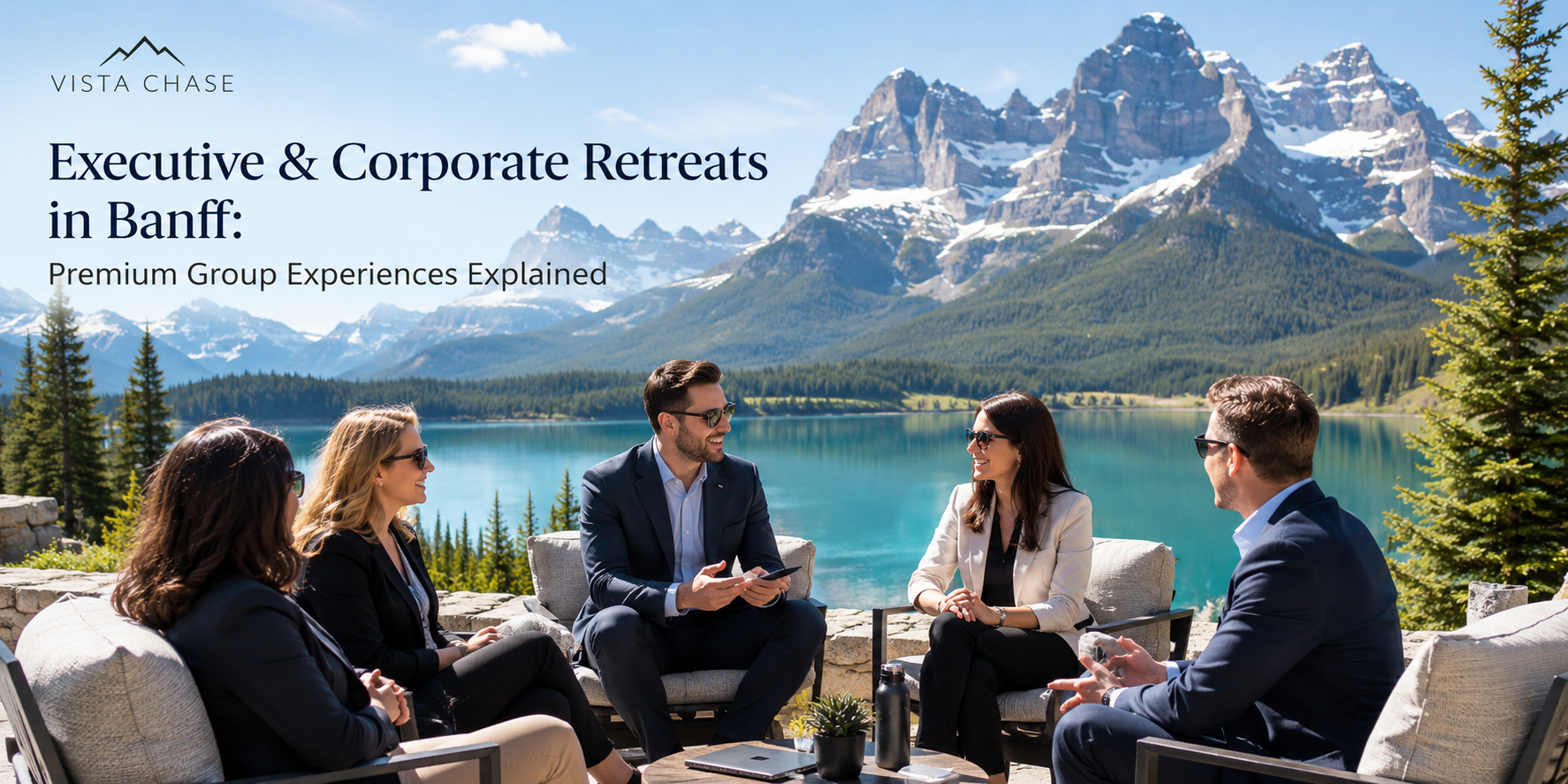
A corporate retreat in Banff can go one of two ways. Either it becomes a hotel conference room with a mountain view nobody has time to look at, or it becomes the trip people are still talking about at the holiday party. The difference rarely comes down to budget. It comes down to how the group actually moves through the day, from the airport to the boardroom to the trail and back.
Calgary is a two-hour flight from most major North American business hubs and Banff is another 90 minutes by road, which is close enough to fit into a normal work week and far enough to feel like a real change of scenery. That combination is why the town has become a default choice for executive offsites, sales kickoffs, and board retreats out of Alberta, British Columbia, and the broader Prairies. Getting the logistics right is what separates a retreat that lands from one that just relocates the same meeting somewhere colder.
Group transport is the part that quietly makes or breaks the trip
The single biggest planning mistake is treating a 12-person leadership team the same way a solo backpacker would treat a shared shuttle. Public shuttles and mixed-group tours run on fixed departure times built around the general public, not around your agenda, and they will not hold a stop because your CFO needed ten more minutes on a call.
A group traveling for business needs a vehicle sized to the group and a schedule built around the retreat, not the other way around. A 7-passenger SUV works for a small leadership team; a Mercedes Sprinter or 15-passenger transit van covers a full department without splitting people across two bookings. One dedicated guide and driver for the entire stay also means one point of contact who already knows the agenda, instead of re-briefing a new guide every morning.
This is the case for booking private tours over anything shared: the itinerary bends to the retreat's schedule, not the reverse.
Structure the days so work and the mountains don't compete
The retreats that work best don't try to cram sightseeing around a full day of sessions. They flip the ratio: mornings for the agenda while everyone is fresh, afternoons for a single well-chosen excursion, evenings open for dinner and informal conversation, which is usually where the actual relationship-building happens anyway.
For a two or three day retreat, a common structure looks like this:
- Day 1: Arrival, airport transfer straight to the hotel, light welcome activity in the late afternoon such as a short gondola ride or a walk along the Bow River.
- Day 2: Morning working sessions, afternoon excursion built around the group's energy level (a guided hike for an active group, a scenic drive and canoe outing for a lower-key one), group dinner in the evening.
- Day 3: Closing session or half-day free block, then a single private transfer back to Calgary timed to everyone's flights instead of one fixed departure.
For retreats running four days or longer, a multi-day tour package built around the group covers Banff, Yoho, and Jasper without anyone needing to rent a car or coordinate separate transport between activities.
Choosing activities that actually work for a group of colleagues
Not every scenic stop makes a good group activity. Iconic photo spots are worth seeing, but they don't give a group of coworkers much to do together beyond standing in the same place. The activities that generate actual conversation and shared memory tend to require some shared effort: a guided hike where people naturally pair off and talk, a canoe outing on Lake Louise or Moraine Lake, a short wildlife-focused drive along the Bow Valley Parkway at dawn, or the Banff Gondola followed by a walk along the ridge.
Winter retreats have their own version of this: a guided walk through a frozen canyon or the ice bubbles at Abraham Lake gives a group something genuinely unusual to talk about, which does more for team cohesion than another off-site dinner ever will.
What executives and offsite planners actually ask for
The people booking these trips are rarely asking about the scenery. They're asking about the logistics that make a group trip either smooth or stressful: can the schedule flex if a flight is delayed, is there one contact for the whole stay instead of a different driver each day, can the vehicle handle mixed group sizes if a few people arrive separately, and how far in advance does this need to be locked in.
The honest answer on timing is early. Vehicles suited to larger groups, particularly during the June through September window, book out weeks ahead, and a retreat with a fixed set of dates does not have the flexibility a solo traveler has to shift a booking by a day or two.
Getting the details right before you book
A retreat planner's version of a site visit is usually a phone call: group size, dates, whether flights are arriving into Calgary at staggered times, and what the group actually wants out of the excursion portion versus the working sessions. Working that out ahead of time is what lets a guide build a day that fits the group instead of a generic itinerary everyone has to adapt to.
For a group retreat, the fastest way to get an accurate plan and quote is to reach out directly with dates and headcount rather than trying to piece one together from a standard tour listing built for individual travelers.
The takeaway
A corporate retreat in Banff earns its cost when the transportation disappears into the background and the days are built around the group instead of a fixed public schedule. That means sizing the vehicle to the team, keeping one guide for the whole stay, and picking one or two activities that actually give people something to do together rather than just something to look at. Get those three things right and the mountain view stops being a backdrop and starts being the reason the retreat worked.