.png)

The Local's Guide to Hiking the Devil's Thumb at Lake Louise
Most people who arrive at Lake Louise take the photo from the shoreline, walk the path along the water, and head back to the car. Then there are the ones who look up at the rock wall above Lake Agnes, spot a jagged tooth of limestone against the sky, and ask what it is.
That tooth is the Devil's Thumb. It's one of the most rewarding objectives near the lake, and it's also one that catches people out. The trail to Lake Agnes is well worn and easy to follow. What lies beyond it is not.
We run tours and shuttles across the Rockies every day of the season, and Lake Louise is where a lot of our guests start. This guide covers what we tell people on the trail: what to expect, when to go, what to carry, and when to turn around.
What the Devil's Thumb actually is
The Thumb is a prominent rock formation on the ridge above Lake Agnes, reached by continuing past the tea house and climbing steeply toward the col. The hike up to Lake Agnes is a maintained trail used by thousands of visitors each summer. The final push toward the Thumb is a different category of outing. It's steep, exposed in places, and involves loose rock and route finding rather than a groomed path.
Think of it as two hikes stacked together. The first is a classic Lake Louise walk. The second is a mountain objective that rewards preparation and punishes overconfidence.
Quick facts
Distances and elevation vary depending on the exact route and the source, so treat these as ballpark figures and check current information from Parks Canada before you go.
- Starting point: Lake Louise lakeshore, in front of the Fairmont Chateau
- Route: Lake Agnes trail, past the tea house, then up toward the ridge
- Round trip: Roughly 10 to 13 km depending on your route
- Elevation gain: Well over 700 m from the lakeshore
- Time: Allow 5 to 7 hours including breaks
- Difficulty: Strenuous, with exposure and scrambling on the upper section
- Best window: Typically July through September, depending on snow
When to go
Snow is the deciding factor. The upper slopes hold snow well into early summer, and a late spring can push the season back by weeks. Hiking this section on lingering snow without the right equipment is a bad idea. We've seen plenty of people turn up in sneakers on a sunny July morning, unaware that the north-facing slopes above them are still holding winter.
Late July through early September is usually the safest window. September brings cooler air, thinner crowds, and golden light, but also shorter days and the occasional early dusting of snow. Always check the forecast the evening before and again at the trailhead.
Start early. The reasons are practical, not romantic:
- Parking at the lake fills up fast, often before most visitors have finished breakfast.
- Afternoon thunderstorms build in the Rockies during summer, and you do not want to be on an exposed ridge when one arrives.
- The tea house gets busy by late morning, and the trail below it turns into a queue.
Aim to be walking by 6:30 or 7:00 a.m. in peak season.
Getting to the trailhead without the parking headache
Parking at Lake Louise is the first challenge of the day, and it catches out many independent travellers. Parks Canada has run shuttle options from an overflow lot in recent seasons, and rules and schedules change, so confirm before you travel.
If you'd rather skip the logistics, our Lake Louise and Moraine Lake shuttle service handles the transport and timing for you. You get dropped at the lake early, and you can focus on the hike instead of circling a full lot. For guests who want a more flexible day, a private tour from Banff can be built around a morning hike with time left for other stops afterward.
The route, section by section
Section 1: Lakeshore to Lake Agnes. From the Chateau, follow the lakeshore path, then the signed trail that climbs through forest in a series of switchbacks. It's steady and shaded, and it gets steeper than most first-timers expect. Go at a pace where you can still hold a conversation. Plenty of hikers burn out here by going too hard, and they pay for it higher up.
Section 2: Lake Agnes and the tea house. You'll emerge at a small alpine lake with a historic tea house on its shore. This is the natural place to eat, drink water, and make an honest assessment. Look at the sky. Look at how your legs feel. Look at the people around you. If anything feels off, this is a perfectly good place to end the day, and no one who turns back here has failed.
Section 3: Beyond the lake toward the Thumb. Continue along the lake's edge and begin the steeper climb. The trail fades, the terrain turns to rock and scree, and you'll need to pay attention to where your feet land. Look ahead and use the natural line of the slope. Keep a few metres between hikers so loose rock doesn't fall onto the person below.
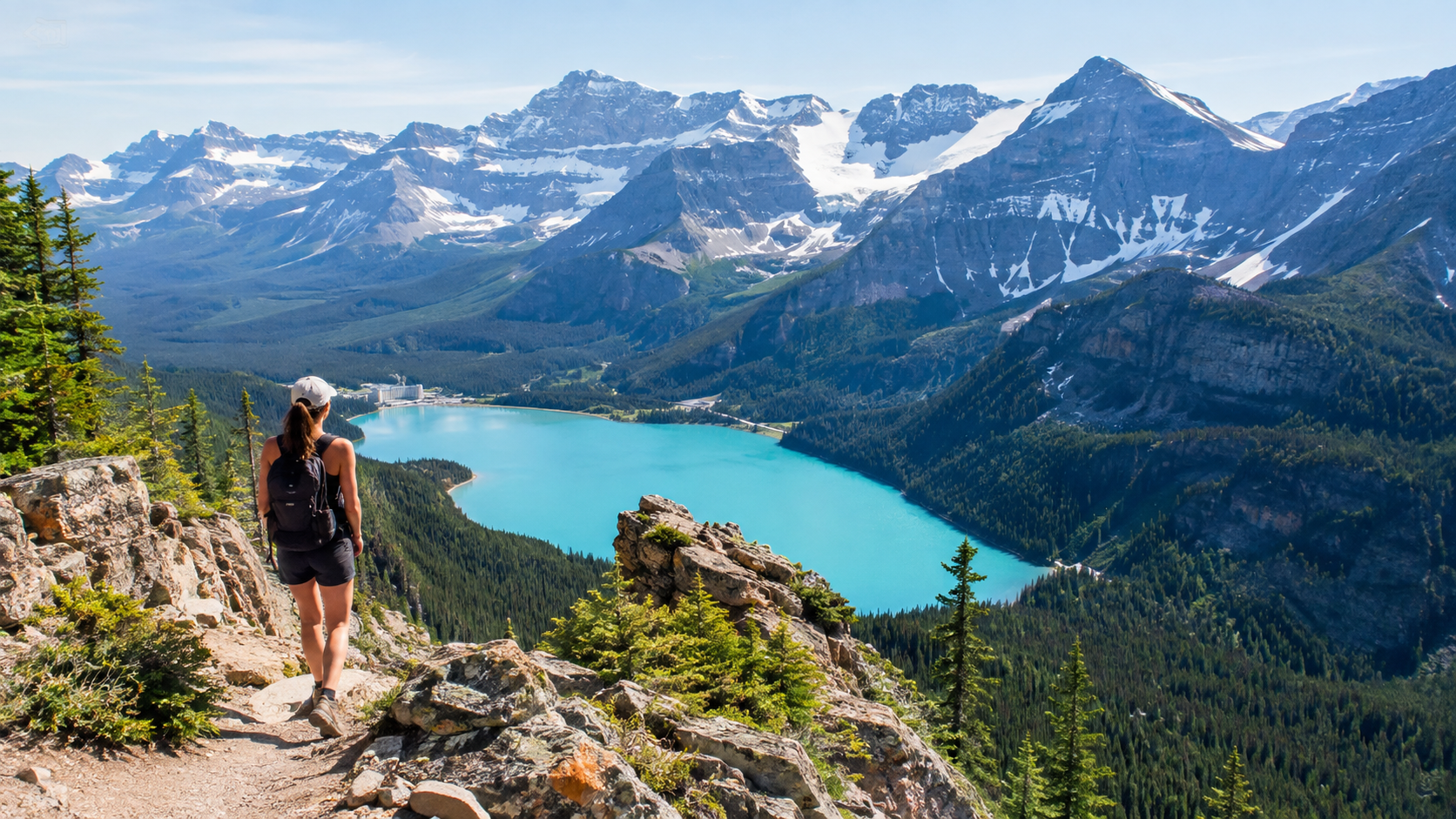
Section 4: The ridge and the Thumb. The views open up dramatically here. Lake Louise sits far below, framed by Victoria Glacier and the surrounding peaks. Exposure increases, and so does the consequence of a slip. Only continue if you're comfortable with heights and confident on loose, uneven ground. Many experienced hikers stop short of the final section, and that's a sound decision.
What to carry
You don't need technical climbing gear, but you do need to treat this like a real mountain day.
- Footwear: Sturdy hiking boots with good tread and ankle support. Trail runners are fine for some, but loose scree is unforgiving.
- Layers: Temperatures can drop 15 degrees or more between the lakeshore and the ridge. Bring a warm layer and a waterproof shell, even on a clear morning.
- Water and food: At least 2 litres per person, plus real food. A candy bar won't carry you through a 6-hour day.
- Bear spray: Carry it where you can reach it in seconds, not buried in your pack. Know how to use it.
- Navigation: A downloaded offline map. Cell service is unreliable.
- Sun protection: Alpine UV is strong, and snow or pale rock makes it worse.
- First aid basics: Blister care, a bandage, and something for pain.
- Trekking poles: Helpful on the descent, which is where knees take the beating.
Safety, honestly
The Rockies don't give second chances to people who treat them casually. A few things we say to every group:
Weather turns fast. A bright morning can become cold rain or hail by early afternoon. If thunder starts, get off the ridge.
Wildlife is real. This is grizzly and black bear country. Make noise on blind corners, stay in a group, and never approach an animal for a photo. Parks Canada occasionally restricts access to certain areas because of bear activity, so check current closures and advisories before you set out.
Know your limits. Exposure, loose rock, and a long descent on tired legs are a combination that causes most incidents. If you're unsure, stop at Lake Agnes. It's a beautiful hike in its own right.
Tell someone your plan. Share your route and expected return time with a person who isn't hiking with you.
None of this is meant to scare you off. It's meant to make sure you finish the day with a story instead of a rescue.
What the crowds don't tell you
The social media version of this hike shows a solitary figure on a ridge in perfect light. The reality is that the trail to Lake Agnes can be busy, especially on weekends and holidays, and the tea house line can stretch out the door. The further you climb, the thinner the crowd becomes, but the terrain also becomes less forgiving.
A weekday morning in September is, in our experience, the best combination of quiet trail and workable conditions. If you can flex your dates, do.
Making a full day of it
The Devil's Thumb is a demanding outing, so many of our guests do it as the centrepiece of a Lake Louise day and keep the rest of the schedule gentle. After you come down, a slow walk along the lakeshore, a late lunch, and an easy afternoon stop at Moraine Lake or Emerald Lake makes a good balance.
If you're building a longer Rockies trip around hiking, our multi-day Canadian Rockies packages let you pair a hard day like this with lighter days of sightseeing, so your legs get a rest without wasting a day. And if you're still deciding what suits your group, our Banff and Lake Louise travel guides cover trails at every level.
Frequently asked questions
Is the Devil's Thumb hike suitable for beginners?
The Lake Agnes portion is suitable for reasonably fit beginners. The section beyond it is not recommended for anyone without scrambling experience or a comfort level with exposure.
Do I need a guide?
Not required, but a guide helps with route finding, pacing, and decision making, particularly if conditions are uncertain. Ask us about options when you plan your trip.
Can I bring children?
Children can enjoy the Lake Agnes section with proper supervision. We wouldn't recommend the upper route for kids.
Are dogs allowed?
Dogs must be on a leash in Banff National Park, but the exposed upper section is not a good place for a dog. Check current Parks Canada rules.
What's the best time of day to start?
Early, ideally before 7:00 a.m., to beat parking pressure and afternoon weather.
Do I need a park pass?
Yes. A valid Parks Canada pass is required in Banff National Park, and you should confirm current pricing and rules on their official site.
Final thoughts from the trail
Hiking the Devil's Thumb is one of those days that sticks with you. The climb through the forest, the stillness at Lake Agnes, the moment the ridge opens up and Lake Louise appears far below: it's the kind of experience that makes people fall for the Rockies.
Respect it, prepare for it, and be willing to turn around. The mountain will still be there next summer.
If you'd like help planning your Lake Louise day, from transport to a full itinerary, get in touch with the Vista Chase team. We live here, we work these roads and trails every season, and we're happy to point you in the right direction.