.png)

The Complete Hiker's Handbook to Lake Louise
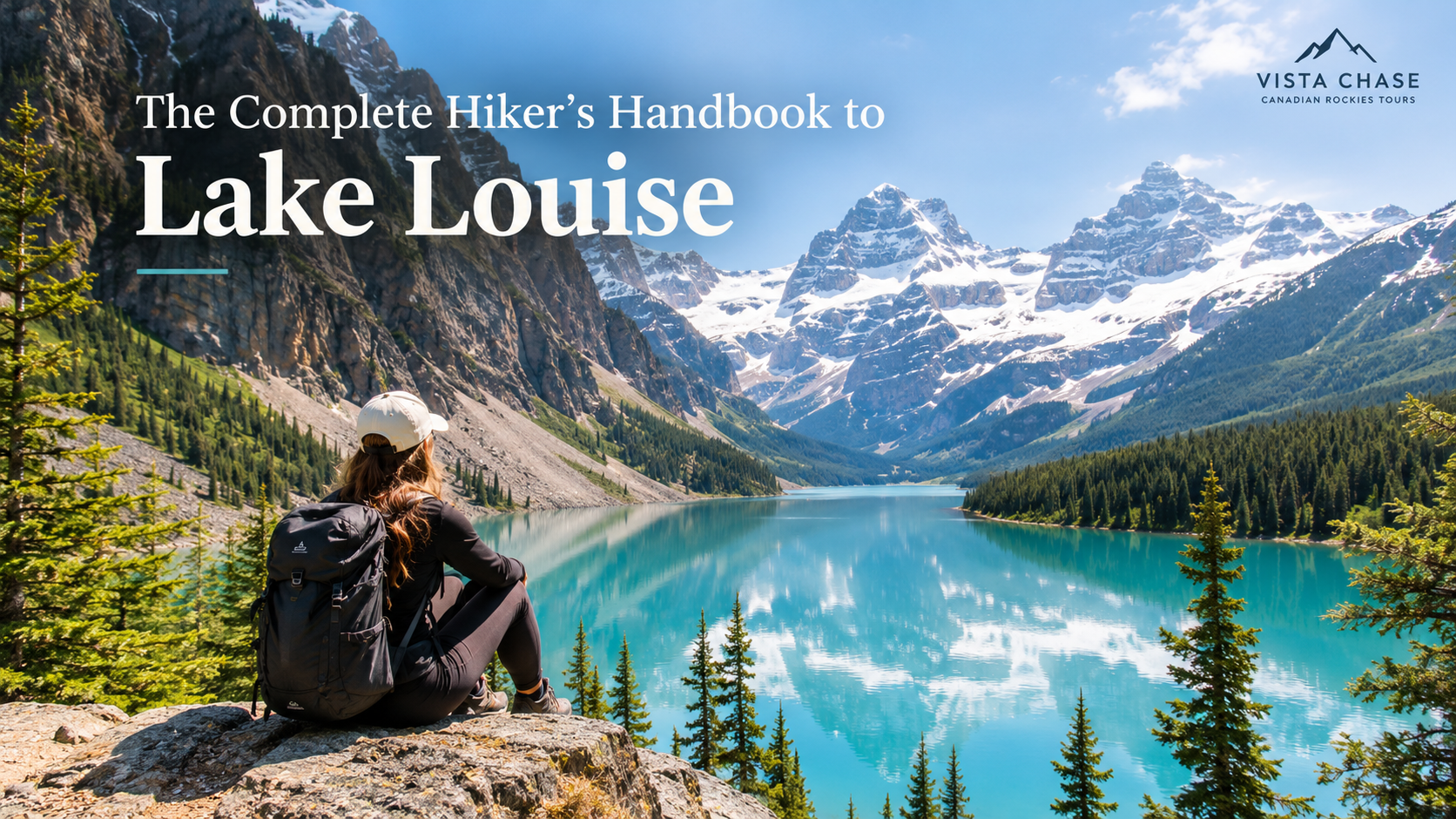
If you only have one day on the trails at Lake Louise, hike to the Lake Agnes Teahouse. It is 7 km return with about 400 metres of climbing, it suits most reasonably fit visitors, and it ends at a log teahouse beside an alpine lake. Beginners and families will be happiest on the flat Lakeshore Trail or the short climb to
Fairview Lookout. Experienced hikers should aim for the Plain of Six Glaciers Trail or the full Teahouse Loop, which links both teahouses in about 14.6 km. The higher trails are usually snow free from July to early October.
That is the short version. This Lake Louise hiking guide is meant to be the complete hiking guide to Lake Louise Canada, so it covers the rest: every major trail with real distances, how to get to the trailhead now that parking is limited and paid, when each trail is at its best, how to handle bear country, and what our
guides at Vista Chase actually tell guests to carry. We drive people to these trailheads most days of the summer, so the advice here comes from watching what goes right and what goes wrong on the ground.
Why Lake Louise Is Called the Hiking Capital of Canada
Parks Canada itself describes the Lake Louise area as the hiking capital of the country, and it is hard to argue. Within a few kilometres of the lakeshore you get glaciers, hanging valleys, two historic teahouses, larch forests and some of the most photographed viewpoints in the Canadian Rockies. Lake Louise sits at
roughly 1,731 metres, so even the trailhead is higher than most cities on earth, and the trails climb from there toward Lake Agnes at about 2,136 metres and the Big Beehive at around 2,270 metres.
What makes hiking in Lake Louise Alberta so appealing is the range. A grandparent and a trail runner can start from the same spot outside the Fairmont Chateau Lake Louise and both have the day of their lives. The catch is that everyone wants to do it, so planning matters more here than almost anywhere else in
Banff National Park.
Lake Louise Hiking Trails at a Glance
Distances below are one way unless stated otherwise, and all of these Lake Louise day hikes start from the Lake Louise Lakeshore near the Chateau.
- Lakeshore Trail: 2 km one way, almost no elevation gain, about 1 hour return. Easy.
- Fairview Lookout: about 1 km one way, roughly 100 m gain, under 1 hour return. Easy with a steady climb.
- Lake Agnes Teahouse: about 3.5 km one way, roughly 400 m gain, 2.5 to 3 hours return. Moderate.
- Little Beehive: an extra 0.9 km beyond Lake Agnes, about 105 m more climbing. Moderate.
- Big Beehive: an extra 1.5 km beyond Lake Agnes, about 135 m more on steep switchbacks. Moderate to challenging.
- Plain of Six Glaciers Teahouse: about 5.5 km one way, roughly 365 m gain, around 4 hours return. Moderate.
- Teahouse Loop via the Highline Trail: 14.6 km loop, about 5 to 6 hours. Challenging but very popular.
- Saddleback Pass: about 3.7 km one way from the boathouse, roughly 600 m gain. Challenging.
Easy Hikes in Lake Louise: Best Hiking Trails for Beginners
If you are new to mountain hiking, travelling with young kids, or adjusting to the altitude after a long flight, start here. These easy hikes in Lake Louise still deliver the views people travel across the world for.
Lakeshore Trail
The Lakeshore Trail follows the north shore of Lake Louise for 2 km to the far end of the lake, where milky meltwater streams pour off the Victoria Glacier and into the turquoise water. It is wide, flat and busy near the Chateau, then thins out quickly. Most people turn around after ten minutes, which is a mistake. The
last stretch, where the cliffs rise above you and the colour of the water changes with the silt, is the best part.
This is the trail to walk at the very start or very end of the day, when the water is still and the crowds are thin. If you are deciding between a dawn or dusk visit, our guide to Lake Louise sunrise vs sunset breaks down the light, the reflections and the crowd levels at each.
Fairview Lookout
Fairview Lookout is a short, steady climb through forest on the south side of the lake, starting near the boathouse. It gains about 100 metres in roughly a kilometre and finishes at a wooden platform looking back over the lake toward the Chateau. It is the quickest way to get a view from above without committing to
a half day, and it is a good test of how your legs and lungs handle the elevation before you try something bigger.
Best Hikes in Lake Louise for a Half Day
These are the trails most visitors mean when they talk about the best hikes in Lake Louise. Each one is achievable for an active person with decent shoes, a few litres of water and a willingness to walk uphill for an hour or two.
Lake Agnes Teahouse Trail
The Lake Agnes trail is the classic. It leaves the lakeshore near the Chateau and switchbacks through forest, gaining around 400 metres in about 3.5 km. Halfway up you reach Mirror Lake, a small, dark pond sitting under the rock face of the Big Beehive, which is a good place to catch your breath. The final push
climbs a set of wooden stairs beside a waterfall and arrives at Lake Agnes and its teahouse.
The teahouse has been serving hikers since the early 1900s. Supplies are carried up by staff, there is no road access, and it gets very busy by late morning in summer. Bring cash, since the teahouses have historically not taken cards, and expect a queue if you arrive after 10 am. The teahouse typically operates
from early June into early October, but dates change with snow, so check before you go if a cup of tea is the whole point.
Little Beehive and Big Beehive Trail
From Lake Agnes you can add one of two viewpoints. The Little Beehive is an extra 0.9 km and about 105 metres of climbing to the site of an old fire lookout, with a wide view down the Bow Valley. The Big Beehive Trail continues around the far end of Lake Agnes, then climbs a tight set of switchbacks to a ridge
and a small wooden gazebo perched directly above Lake Louise. It is about 1.5 km from the teahouse and roughly 135 metres more, but it is steep, and the switchbacks can hold snow into July.
If you only have energy for one, pick the Big Beehive. Looking straight down on the lake, with the Chateau looking like a toy at the far shore, is the view that ends up on most people's phone wallpaper.
Plain of Six Glaciers Trail
The Plain of Six Glaciers Trail is the best glacier walk in the area and arguably the best of all the scenic hiking trails Alberta has to offer that does not require a technical background. It starts as an extension of the Lakeshore Trail, then climbs gradually up the valley beyond the lake, gaining around 365 metres over
about 5.5 km to reach the Plain of Six Glaciers Teahouse, a stone and log building that has been operating since the late 1920s.
The grade is gentler than the Lake Agnes trail, but the distance is longer and the final section crosses open moraine with no shade. Past the teahouse, a rougher path continues about another kilometre to a viewpoint facing the Victoria Glacier and the gap of Abbot Pass. On warm afternoons you can hear ice
breaking off the hanging glaciers across the valley. Treat that as your reminder that this is real mountain terrain: stay on the trail and do not walk onto the glacier or the snow slopes below it.
Lake Louise Day Hikes for Strong Hikers
The Teahouse Loop via the Highline Trail
Many experienced hikers combine both teahouses into one loop. Hike up to Lake Agnes, continue past the lake and over the Big Beehive, drop down to the Highline Trail, follow it to the Plain of Six Glaciers Trail, visit the second teahouse, then walk back along the lakeshore. Parks Canada lists the loop at about 14.6
km, and most fit hikers take 5 to 6 hours with breaks.
Do it in this direction. The steep climb comes first while your legs are fresh, and the long, gentle descent along the lake is easy on tired knees. Start early, because the loop leaves little margin if you also want time at the teahouses.
Saddleback Pass and Fairview Mountain
For a big climb with fewer people, the trail to Saddleback Pass starts near the boathouse and gains roughly 600 metres in about 3.7 km. It is steep and relentless, but it opens onto an alpine meadow with a huge view of Mount Temple and the Paradise Valley side of the range. In late September the larches up here
turn gold. Very strong hikers sometimes continue to the summit of Fairview Mountain from the pass, which is a scramble on loose rock and should only be attempted in dry conditions by people comfortable with exposure.
Moraine Lake Hiking: Worth Adding to Your Day
Moraine Lake is about 14 km from Lake Louise by road and is the obvious second stop on any hiking day. The road is closed to private vehicles, so in season you reach it by Parks Canada shuttle, the Lake Connector, Roam Transit's Super Pass, or a licensed tour operator.
- The Rockpile Trail is a short climb to the famous Valley of the Ten Peaks viewpoint, only a few minutes from the shuttle stop.
- Consolation Lakes is about 3 km one way through forest and boulder fields with very little climbing, ending at a quiet pair of alpine lakes.
- Larch Valley climbs steadily through forest into a meadow of larch trees under the Ten Peaks, and continues up to Sentinel Pass, about 5.6 km from the lake with roughly 750 metres of total gain.
Moraine Lake hiking comes with one rule that catches visitors out. During the busy part of the season, usually from mid July, Parks Canada requires hikers to travel in a tight group of four or more on trails including Larch Valley, Sentinel Pass, Eiffel Lake and Consolation Lakes, because of grizzly bear activity. The
Rockpile and Lakeshore trails are not included. If you are a couple, you can team up with other hikers at the trailhead, which is normal and expected.
How to Read the Lake Louise Trail Map
The Lake Louise trail map looks confusing at first because so many trails branch off one another, but the logic is simple once you understand that almost everything starts at the same place. From the lakeshore in front of the Chateau, the Lakeshore Trail runs west along the water and becomes the Plain of Six
Glaciers Trail. The Lake Agnes trail leaves the lakeshore a few hundred metres from the Chateau and climbs north. The Highline Trail is the connector that runs high along the slope between the two, which is what lets you make the loop.
On the south side of the lake, near the canoe boathouse, two trails start close together: the short spur to Fairview Lookout and the longer climb to Saddleback. Junctions are well signed, and the official Parks Canada map of the Lake Louise area, available online and at the Lake Louise Visitor Centre in Samson Mall,
shows current distances and any seasonal closures. Download it before you go, because mobile signal on the upper trails is patchy.
Best Time to Hike in Lake Louise Alberta
The best time to hike in Lake Louise Alberta depends on which trail you want, because snow melts from the bottom up.
June is shoulder season on the trails. The Lakeshore Trail and Fairview Lookout are usually clear, but Lake Agnes can still be partly frozen, the Big Beehive switchbacks hold snow, and the upper Plain of Six Glaciers Trail crosses avalanche paths that may not have fully released. If you hike in June, carry
microspikes and turn around when the trail disappears under snow.
July and August are peak season. The higher trails are open, the wildflowers are out, the lake is at its most vivid turquoise, and everyone else knows it. Start before 8 am if you want any quiet at all, and expect afternoon thunderstorms on hot days.
Mid September to early October is our favourite window. The crowds ease, the air is crisp, and the larches around Saddleback, Larch Valley and the Lake Agnes area turn gold for roughly two to three weeks, usually peaking in the last week of September. Mornings can be below freezing, and an early snowfall can
close the higher trails for a few days at a time.
From mid October through May, treat Lake Louise as a winter destination. The lakeshore and the frozen lake are lovely for walking and snowshoeing, but the routes to Lake Agnes, the Beehives and the Plain of Six Glaciers cross avalanche terrain. Unless you have avalanche training and equipment, stay low.
Getting to the Trailhead: Parking, Shuttles and Park Passes
Every hiking day at Lake Louise begins with the same question: how will you get to the lake? The Lake Louise Lakeshore parking lot is paid from mid May to mid October, at $42 per vehicle per day in 2026, and on summer mornings it is often full before most visitors have finished breakfast. Once it fills, traffic staff
turn cars away at the bottom of the hill.
Your main alternatives are the Parks Canada shuttle from the Lake Louise Park and Ride at the ski resort, which runs from mid May to mid October and needs an advance reservation, and Roam Transit Route 8X from Banff. A Parks Canada shuttle reservation also gives you access to the Lake Connector between
Lake Louise and Moraine Lake. Overnight parking at the lakeshore is not allowed unless you hold a backcountry permit. For fees, free parking spots and the full set of rules, see our complete Banff parking rules guide.
You also need a valid Parks Canada pass to hike anywhere in Banff National Park. A daily pass is $12.25 per adult in 2026, youth 17 and under enter free, and the pass is separate from any parking or shuttle fee. Entry was free for everyone from June 19 to September 7, 2026 under the Canada Strong Pass, but
standard fees applied before and after that window.
What to Pack for Hiking in Lake Louise
Lake Louise weather changes fast. We regularly pick guests up in Banff in sunshine and drop them at the lake into wind and sleet. Pack for the top of the trail, not the parking lot. Here is what to pack for hiking in Lake Louise on a typical summer day hike:
- Sturdy hiking shoes or boots with good grip. Trail runners are fine in dry weather; leave the sneakers with smooth soles at the hotel.
- A waterproof jacket and a warm mid layer, even in August. It can be 25 degrees at the lake and close to freezing at the Big Beehive.
- Bear spray in a holster on your hip or chest strap, not buried in your pack.
- At least 1.5 to 2 litres of water per person, plus snacks. You can buy food at the teahouses, but do not rely on it.
- Sunscreen, sunglasses and a hat. UV is stronger at altitude and there is little shade on the Plain of Six Glaciers moraine.
- Cash for the teahouses.
- A phone with the Parks Canada map downloaded, and a small power bank.
- Microspikes in June, late September and October, when shaded sections ice over.
If you are visiting in a different season or on a longer trip, our season-by-season Banff packing list covers clothing for every month of the year.
Trail Safety: Bears, Weather and Altitude
Are there bears on Lake Louise hiking trails?
Yes. Both grizzly bears and black bears live around Lake Louise, and the area has some of the most closely studied grizzly populations in the Rockies. Parks Canada regularly posts warnings, group size rules and temporary closures here, particularly in late summer when bears feed on buffaloberries along the
trails. Sharing the trail with wildlife is part of mountain hiking in Canada, and seeing a bear from a distance is a privilege. Surprising one at close range is the situation you want to avoid.
- Make noise on blind corners and near streams, where water drowns out your voice.
- Hike in a group and keep children close.
- Carry bear spray where you can reach it in a second, and know how to use it before you need it.
- Never leave food, wrappers or garbage on the trail.
- Check the Parks Canada trail conditions report on the morning of your hike for closures and warnings.
Weather and altitude
Thunderstorms build quickly over the Lake Louise peaks on hot afternoons. If you hear thunder, get off ridges like the Big Beehive and Saddleback. The altitude is moderate, but visitors arriving from sea level often feel it on the first climb. Go slower than you think you need to, drink water, and give yourself a day
of easier walking before attempting the Teahouse Loop.
How Difficult Are the Hikes in Lake Louise?
Lake Louise has something at every level. The Lakeshore Trail and Fairview Lookout suit almost anyone who can walk for an hour. Lake Agnes, the Beehives and the Plain of Six Glaciers are moderate hikes with sustained climbing that most active adults manage comfortably if they take breaks. The Teahouse Loop
and Saddleback are long or steep enough to be genuinely hard for people who do not hike regularly. A useful rule: if you can comfortably climb stairs for 45 minutes with short rests, Lake Agnes is within reach.
Sample Lake Louise Hiking Days
A relaxed beginner's day: walk the Lakeshore Trail early, climb to Fairview Lookout, rent a canoe or have lunch at the Chateau, then ride the Lake Connector to Moraine Lake for the Rockpile viewpoint.
The classic first visit: hike to Lake Agnes for tea, add the Little Beehive or Big Beehive, and walk back down in time for an afternoon stroll along the lake.
The big day: start the Teahouse Loop at 7 am, go up to Lake Agnes and over the Big Beehive first, take the Highline Trail across to the Plain of Six Glaciers, and finish with a slow walk along the lakeshore in the late afternoon.
The two lakes: spend the morning on Lake Agnes or the Plain of Six Glaciers, then take the Lake Connector to Moraine Lake for Consolation Lakes or Larch Valley, remembering the group of four rule.
Hiking Lake Louise with Vista Chase
The hardest part of a Lake Louise hiking day is often everything that happens before you reach the trailhead: the parking, the shuttle reservations, the timing. That is the problem our full-day shuttle to Lake Louise and Moraine Lake is built to solve. It picks up in Canmore, Banff and Lake Louise Village, includes
your Parks Canada entry, and gives you about four hours at Lake Louise and three at Moraine Lake, with a local guide and a maximum of 12 guests. Four hours is enough for the Lake Agnes Teahouse with the Little Beehive, or for the Plain of Six Glaciers Teahouse at a steady pace. If your heart is set on the full
Teahouse Loop, ask us about a private tour so the schedule can be built around your hike.
Our guides know which trails are clear, where the bear warnings are posted that week, and when the teahouse queue is shortest. That local knowledge is the difference between a rushed visit and a great day in the mountains.
Frequently Asked Questions About Hiking in Lake Louise
What are the best hiking trails in Lake Louise?
The best hiking trails in Lake Louise are the Lake Agnes Teahouse trail, the Big Beehive Trail, the Plain of Six Glaciers Trail and the Teahouse Loop that links them using the Highline Trail. For an easy option, the Lakeshore Trail and Fairview Lookout give big views with very little climbing.
When is the best time to hike in Lake Louise?
July to mid September is the best time to hike in Lake Louise for snow-free trails and open teahouses. Mid September to early October is ideal for fewer crowds and golden larches. In June the higher trails often still hold snow, and from mid October to May the upper routes cross avalanche terrain.
Are Lake Louise hiking trails suitable for beginners?
Yes. The Lakeshore Trail is flat and 2 km each way, and Fairview Lookout is a short climb of about 100 metres. Many fit beginners also complete the Lake Agnes Teahouse trail, which is 7 km return with about 400 metres of climbing, as long as they go slowly and take breaks.
Do I need a park pass to hike in Lake Louise?
Yes. Lake Louise is inside Banff National Park, so every visitor needs a valid Parks Canada pass. A daily adult pass is $12.25 in 2026 and youth 17 and under are free. The pass does not cover parking at the Lake Louise Lakeshore or shuttle tickets, which are paid separately.
How difficult are the hikes in Lake Louise?
Difficulty ranges from easy to challenging. The Lakeshore Trail and Fairview Lookout are easy. Lake Agnes, the Beehives and the Plain of Six Glaciers are moderate, with 350 to 550 metres of climbing. The 14.6 km Teahouse Loop and the steep Saddleback Pass trail are the hardest of the popular day hikes.
What should I pack for hiking in Lake Louise?
Pack sturdy hiking shoes, a waterproof jacket, a warm layer, bear spray, at least 1.5 to 2 litres of water, snacks, sunscreen, sunglasses and cash for the teahouses. Add microspikes in early summer and fall, when shaded sections of trail can be icy.
Are there bears on Lake Louise hiking trails?
Yes. Grizzly and black bears are active around Lake Louise from spring to fall. Carry bear spray within reach, make noise, hike in groups and check the Parks Canada trail report before you go. Some nearby trails at Moraine Lake require groups of four or more during peak bear season.
Is parking available at Lake Louise for hikers?
Yes, but it is limited. The Lake Louise Lakeshore lot is paid from mid May to mid October, costs $42 per vehicle per day in 2026, and often fills very early on summer mornings. Overnight parking is not allowed without a backcountry permit. Many hikers use the Parks Canada shuttle from the Park and Ride, Roam
Transit, or a tour or shuttle operator instead.
Can I hike Lake Louise in one day?
Yes. In one day you can complete the Teahouse Loop, which visits Lake Agnes, the Big Beehive and the Plain of Six Glaciers in about 14.6 km and 5 to 6 hours. If you prefer a lighter day, the Lake Agnes Teahouse hike takes 2.5 to 3 hours return and leaves time to visit Moraine Lake as well.
Which Lake Louise hike offers the best mountain views?
The Big Beehive offers the best view of Lake Louise itself, looking straight down on the water from a gazebo on the ridge. For mountain and glacier views, the Plain of Six Glaciers Trail is hard to beat, finishing beneath the Victoria Glacier and Mount Lefroy. Saddleback Pass gives the best view of Mount Temple.
Before You Go
Check the Parks Canada trail conditions report the morning of your hike, sort out your transport the day before, and start earlier than feels reasonable. Get those three things right and Lake Louise will take care of the rest.