.png)

Lake Louise Sunrise vs Sunset: Which Is Better? (Complete 2026 Guide)
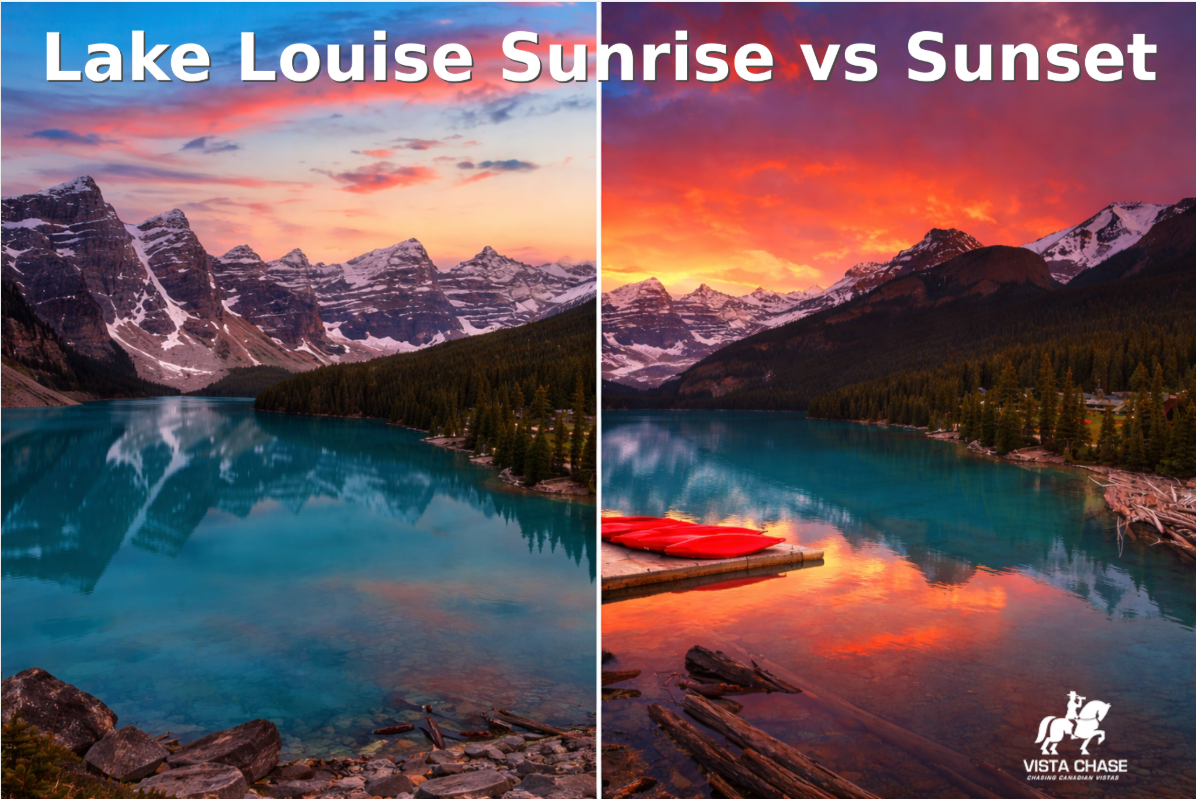
Lake Louise is one of the most photographed lakes in the world. Tucked inside Banff National Park in the Canadian Rockies, this glacier-fed, turquoise gem draws hundreds of thousands of visitors every year.
At Vista Chase, we help travellers experience both, and knowing when to go can completely change your visit.
Should you visit Lake Louise at sunrise or sunset?
The honest answer is that neither time wins outright. Sunrise and sunset at Lake Louise offer two genuinely different experiences: the light shifts, the crowds shift, the photography opportunities shift, and even the mood of the lake changes with them.
In this guide, we break down every part of that debate so you can plan around what actually matters to you, whether you're a photographer chasing the perfect reflection shot, a first-time visitor hoping for a quieter moment, or someone who just wants to see one of the most beautiful lakes on Earth for yourself.
Understanding Lake Louise: Why Timing Matters So Much
Before we compare sunrise and sunset directly, it is worth understanding what makes Lake Louise unique and why timing your visit correctly is so important.
Lake Louise sits at an elevation of approximately 1,731 metres (5,679 feet) above sea level. It is surrounded by steep mountain peaks on three sides, with the iconic Victoria Glacier visible at the far end. This geography has a dramatic effect on light. The surrounding mountains create shadows that move across the lake at specific times of day, which means the window of perfect light is narrower here than at many other locations.
The lake is also extremely popular. During summer months, the Fairmont Chateau Lake Louise parking lot fills up before 6:00 AM on many days. Parks Canada frequently closes the access road to private vehicles when the parking lot reaches capacity. This means arriving at the wrong time can mean missing the lake entirely or spending your visit surrounded by hundreds of other tourists.
Understanding the relationship between light, crowds, and season is the key to planning a visit that exceeds your expectations.
If you looking for Banff to Jasper Private tours, book us now.
Lake Louise Sunrise: What to Expect
The Light at Sunrise
Lake Louise faces roughly east-southeast, which means the rising sun hits the Victoria Glacier and the back wall of the mountains first, before gradually filling the valley with warm light. During the golden hour at sunrise, the mountains behind the lake glow with shades of pink, orange, and deep amber. This light reflects directly onto the surface of the lake, creating mirror-like reflections that are the hallmark of the most iconic Lake Louise photographs you have seen online.
The light at sunrise is softer and cooler in colour temperature compared to sunset. Photographers often describe it as cleaner and more neutral, which makes post-processing easier and gives images a crisp, vivid quality.
Crowd Levels at Sunrise
Sunrise is the least crowded time to visit Lake Louise. While it is no longer truly empty even at dawn due to the lake's extraordinary popularity, arriving 30 to 45 minutes before sunrise gives you a genuine chance of finding the lakeshore relatively quiet. To avoid the parking problem entirely, many visitors book a Lake Louise sunrise shuttle that guarantees access without the early morning parking stress. The famous Fairmont Chateau Lake Louise will be lit up in the background, the air will be still, and the lake surface will often be perfectly calm.
By 7:00 AM to 8:00 AM in summer, crowds begin to build rapidly. Tour buses arrive, guided groups gather at the shoreline, and the peacefulness of early morning disappears quickly. This means the window of calm at sunrise is real but narrow.
Water Reflections at Sunrise
One of the most compelling reasons photographers and travellers favour sunrise is the quality of the water reflections. Wind at Lake Louise tends to pick up as the day progresses, which disturbs the lake surface and breaks up reflections. Early morning, before the wind develops, is when the lake is most likely to be glass-calm.
A calm sunrise at Lake Louise, with the mountains and glacier reflected perfectly in the turquoise water, is widely considered one of the most beautiful natural scenes in North America. If this kind of image or experience is what you are after, sunrise is your best opportunity.
Practical Tips for Lake Louise Sunrise
- Arrive at least 30 to 45 minutes before the published sunrise time.
- Check the Parks Canada website the day before to confirm road access status. A simpler option is to book a shuttle to Lake Louise so parking and access are handled for you.
- Bring warm layers even in summer as temperatures near the lake can be very cold before dawn.
- Use a tripod for long-exposure shots in the low pre-dawn light.
- Walk to the far end of the lakeshore for a different perspective than the classic hotel-fronted view.
Planning a bigger Canada trip? Check out our complete guide to Calgary Stampede 2026 the world's greatest outdoor show, just a short drive from Banff.
Lake Louise Sunset: What to Expect
The Light at Sunset
Here is something that surprises many first-time visitors: the classic warm golden sunset light does not directly illuminate the lake surface at Lake Louise in the same way it does at sunrise. Because the lake is surrounded by tall mountains to the west and northwest, the direct sunlight disappears from the valley well before the actual sunset time. What you get instead is a beautiful alpenglow effect.
Alpenglow occurs when the sun dips below the horizon and the last rays of light paint the mountain peaks in shades of deep orange, red, and purple. At Lake Louise, this effect can be absolutely stunning, turning the Victoria Glacier and the surrounding peaks into a glowing wall of warm colour. The sky above the mountains can display incredible hues, and the overall atmosphere is dramatic and deeply romantic.
The light at sunset, while different from sunrise, is warmer in colour temperature. For photographers, this warmth can add a richness and depth to images that the cooler sunrise light does not always provide.
Crowd Levels at Sunset
Sunset at Lake Louise is significantly more crowded than sunrise. Most guided tours and day-trippers plan their visits during the daytime, and many linger through the late afternoon into the early evening. By the time the alpenglow begins, there can be hundreds of people at the lakeside.
If crowds bother you, sunset is the more challenging time to visit. That said, if you position yourself thoughtfully and arrive with realistic expectations, you can still find good spots and have a meaningful experience.
Water Reflections at Sunset
Because wind at Lake Louise typically builds during the day and does not always die down by evening, water reflections at sunset are less reliable than at sunrise. On calm evenings, especially in autumn when the air settles earlier, you can still get extraordinary reflections. But statistically, the chance of a glass-calm lake at sunset is lower than at sunrise.
Practical Tips for Lake Louise Sunset
- Arrive at least one hour before the published sunset time to find a good position.
- Focus on the mountain peaks and glacier rather than expecting direct sunlight on the lake surface.
- Autumn evenings from late August through mid-October often offer the most dramatic alpenglow.
- Stay 20 to 30 minutes after sunset as the post-sunset sky can produce remarkable colour.
- Consider the Plain of Six Glaciers Trail for an elevated perspective during sunset hours.
Lake Louise Morning vs Evening: A Side-by-Side Comparison
To make this comparison as clear as possible, here is a direct breakdown of the key differences between visiting Lake Louise at sunrise versus sunset:
Light Quality
Sunrise: Soft, cool, clean golden light directly illuminating the mountains and reflecting on the lake. Ideal for crisp, vibrant photography.
Sunset: Warmer alpenglow effect on the peaks. Direct sun leaves the valley floor before sunset, creating dramatic but indirect lighting.
Crowd Levels
Sunrise: Significantly less crowded. Best chance for a peaceful, quiet experience at the lake.
Sunset: Much more crowded. The lake is busiest from midday through early evening.
Water Reflections
Sunrise: More reliable. Wind is typically calm in the early morning, producing mirror-like reflections.
Sunset: Less reliable. Wind often disrupts the lake surface by late afternoon and evening.
Photography Opportunity
Sunrise: Superior for reflection shots, landscape photography, and images without crowds in the foreground.
Sunset: Better for dramatic sky photography, alpenglow shots, and atmospheric travel images.
Overall Atmosphere
Sunrise: Peaceful, serene, almost meditative. The lake at dawn has a stillness that is hard to find at any other time.
Sunset: More lively and social. The energy of other visitors can add to the experience for some people, though it can feel overwhelming for others.
Best Time to Visit Lake Louise for Photography
If you are visiting Lake Louise specifically for photography, sunrise is almost universally recommended by professional landscape photographers. The reasons are straightforward and consistent.
Early mornings at Lake Louise offer the combination of ideal light, calm water, and fewer people in the frame. The turquoise colour of the water appears most vivid in early morning light when the sky is bright but the sun is still low. The reflections of the mountains in the lake surface are most reliable before wind develops.
That said, sunset photography at Lake Louise is not without value. The alpenglow on the Victoria Glacier and the surrounding peaks can produce extraordinary images, particularly from the elevated vantage points along the Plain of Six Glaciers Trail or the Big Beehive Trail. A private Lake Louise tour is the best way to reach these elevated spots at the right time without worrying about logistics. Wide-angle shots of the mountains bathed in post-sunset colour with the chateau silhouetted below are genuinely compelling.
Photography Tips for Sunrise at Lake Louise
- Set up your tripod at the water's edge, aiming toward the Victoria Glacier, at least 20 minutes before the sun rises.
- Use a polarising filter to enhance the turquoise colour of the water and reduce glare.
- Shoot in RAW format to maximise your ability to manage the high dynamic range of the scene.
- Experiment with long exposures in the pre-dawn period to capture smooth water and soft light transitions.
- Walk along both the north and south shorelines for different angles and compositions.
Photography Tips for Sunset at Lake Louise
- Position yourself on the elevated trails above the lake for the best alpenglow compositions.
- Use a telephoto lens to compress the distance between the mountains and the lake.
- Stay through the blue hour after sunset for a different but equally beautiful quality of light.
- Include the Fairmont Chateau Lake Louise in your composition for images that give a sense of scale.
When to Visit Lake Louise for Best Views by Season
Summer (June to August)
Summer is the most popular season at Lake Louise. The lake is ice-free, the surrounding meadows are in full bloom, and the hiking trails are accessible. Sunrise in summer occurs between approximately 5:20 AM and 6:00 AM, and sunset falls between 9:30 PM and 10:00 PM. The long days mean both sunrise and sunset are accessible without extreme early wake-up calls or very late nights.
The trade-off is that summer is the most crowded season by a significant margin. For sunrise visits, arriving by 5:00 AM is strongly recommended. The parking lot fills completely on many summer mornings before 6:00 AM.
Autumn (September to October)
Autumn is considered by many photographers and experienced travellers to be the single best time to visit Lake Louise. Crowds are lower than in summer, the light is more dramatic as the sun sits lower in the sky, and the surrounding larch forests turn brilliant gold in late September and early October. If you are visiting in autumn, also read our guide on the best time to visit Moraine Lake for photos another iconic Rockies gem at its finest in fall. The larch trees above Lake Louise are famous, and combining a larch walk with a sunrise at the lake is a bucket-list experience.
Autumn sunrises occur later, between 7:00 AM and 8:00 AM, making them far more manageable logistically. Alpenglow at sunset is frequently at its most dramatic in autumn as well.
Winter (November to March)
Winter at Lake Louise is extraordinarily beautiful and profoundly underrated. The frozen lake is used for skating, the surrounding mountains are blanketed in snow, and the tourist numbers drop dramatically. Sunrise in winter occurs between approximately 8:30 AM and 9:00 AM, making it by far the most accessible sunrise of the year.
The combination of snow, ice, mountain light, and solitude makes winter sunrise at Lake Louise one of the most remarkable natural experiences available in Canada. Dress in proper cold-weather layers as temperatures regularly drop below minus 20 degrees Celsius.
Spring (April to May)
Spring is a transitional season at Lake Louise. The lake may still be partially frozen in April, and the surrounding trails are often snow-covered and muddy. However, spring offers dramatically reduced crowds and the chance to witness the lake in a state of change as the ice begins to break up. Photographers who visit in late May can capture images of partially frozen turquoise water that are genuinely unlike anything visible in summer.
Lake Louise Lighting Conditions: What the Experts Know
Understanding Lake Louise lighting conditions goes beyond simply knowing when the sun rises and sets. Several additional factors affect the quality of light on any given visit.
The Alpenglow Window
Alpenglow at Lake Louise typically begins 15 to 20 minutes before sunrise (pre-dawn alpenglow) and again 15 to 25 minutes after sunset (post-sunset alpenglow). Many photographers consider the pre-dawn alpenglow window to be the single most beautiful light of the day at Lake Louise, as the peaks and glacier glow in shades of deep pink and violet before the sun itself appears.
Cloud Cover and Overcast Days
Dramatic cloud cover can transform both sunrise and sunset at Lake Louise into something extraordinary. Partially cloudy skies catch and reflect light in complex ways, creating dynamic and unpredictable colour displays that clear skies cannot produce. If you arrive on an overcast morning, do not immediately despair. The window around sunrise and sunset can open up briefly even on cloudy days and produce spectacular results.
Wind and Water Conditions
As noted throughout this guide, wind is the primary enemy of reflections at Lake Louise. Wind at the lake is influenced by the valley's geography and tends to follow predictable patterns. Early morning hours from roughly 4:00 AM to 8:00 AM are statistically the calmest. Afternoons and evenings are when wind most commonly develops, which is a key structural advantage of sunrise over sunset for reflection photography.
The Turquoise Colour of the Lake
The extraordinary turquoise colour of Lake Louise comes from rock flour suspended in the glacial meltwater. This colour is at its most vivid and saturated in late summer when glacial melt is at its peak. In early summer and autumn, the colour shifts slightly toward a greener tone as the melt volume decreases. The colour appears most intense in overhead midday light but is most beautifully complemented by the warm tones of golden hour light at sunrise.
Banff Lake Louise: Sunrise or Sunset for First-Time Visitors?
If you are visiting Banff National Park and Lake Louise for the first time and can only choose one time of day, the recommendation of experienced guides and photographers is consistent: go at sunrise. If it is your first visit, joining a shared Lake Louise tour is a great way to experience sunrise with an expert local guide who handles all the logistics.
Here is why sunrise wins for first-time visitors specifically.
First, the experience of arriving at Lake Louise before dawn, watching the sky gradually lighten and the mountains emerge from darkness, and then witnessing the first rays of sun touch the Victoria Glacier is a genuinely transformative moment. It is the kind of experience that stays with you for the rest of your life.
Second, the absence of large crowds at sunrise means you can actually be present with the landscape. You can stand at the water's edge, hear the silence, and feel genuinely connected to the place rather than being swept along in a tide of tour groups.
Third, the practical photography results at sunrise are more reliably excellent. Even non-photographers with a smartphone camera will capture images that look stunning at sunrise, because the combination of calm water, reflections, and golden light is almost foolproof.
Sunset is absolutely worth experiencing and should not be dismissed. But if you have to choose, sunrise is the answer.
Is Lake Louise Crowded at Sunrise? The Truth
This is one of the most commonly asked questions about visiting Lake Louise, and the honest answer requires some nuance.
Lake Louise is no longer the hidden gem it was two decades ago. It is one of the most famous natural sites in North America, and visitor numbers have grown enormously. Saying that sunrise is uncrowded in absolute terms would be misleading. What is true is that sunrise is the least crowded time to visit, and the difference between sunrise and midday crowds is significant.
On a typical summer morning, arriving at 5:00 AM to 5:30 AM will result in a far smaller number of people at the lakeshore than arriving at any other time of day. You may share the space with a few dozen dedicated photographers and early-rising visitors, rather than hundreds or potentially thousands.
Weekdays are consistently less crowded than weekends. Shoulder season months of May, June, September, and October have fewer visitors than July and August. Many travellers combine both lakes on the same morning read our guide on doing a Lake Louise and Moraine Lake tour in one day to plan the perfect itinerary.
Can You See the Sunset at Lake Louise? Understanding the Valley Geography
Yes, you can absolutely see the sunset at Lake Louise, but it is important to set the right expectations about what that experience involves.
Lake Louise is positioned in a valley that runs roughly east to west, with the Victoria Glacier at the western end. The mountains to the west and northwest rise steeply and block the direct view of the sun on the horizon. This means the sun itself disappears from view at the lake level well before the astronomical sunset time.
What you see instead of a direct sunset is the alpenglow effect described earlier in this guide. The mountains and glacier catch the last sunlight and glow warmly even after direct sun has left the valley floor. The sky above the peaks can display extraordinary colour. On a clear evening with dynamic cloud cover, the display can be breathtaking.
For those who want to see the sun actually setting rather than just the alpenglow, hiking to an elevated position such as the Big Beehive, which sits at approximately 2,270 metres elevation, opens up a wider view of the sky and allows you to see the sun much closer to the actual horizon before it disappears.
What Is the Best Time for Photography at Lake Louise? The Definitive Answer
Based on light quality, crowd levels, water conditions, and overall photographic opportunity, the definitive ranking of best times for photography at Lake Louise is as follows.
- Pre-dawn to golden hour at sunrise: The single best time for photography. Calm water, excellent reflections, ideal light, fewest crowds.
- Late autumn sunrise (September to October): As above, with the added bonus of larch foliage and lower visitor numbers.
- Post-sunset blue hour: The sky takes on a deep blue tone after sunset that creates beautiful, moody images of the lake and chateau.
- Winter sunrise: Dramatic snow and ice conditions with minimal crowds. Requires proper preparation for cold.
- Alpenglow at sunset: Excellent for mountain peak photography, particularly from elevated trail positions.
Do You Need to Arrive Early for Lake Louise Sunrise? How Early Is Early?
The short answer is yes, arriving early is strongly recommended. The longer answer involves understanding what early means in practice across different seasons.
Summer Sunrise Timing
In July and August, the sun rises before 6:00 AM. To secure a good position at the lakeshore and, critically, a parking space, arriving by 5:00 AM is the minimum recommendation. Arriving by 4:30 AM is better. Some photographers arrive between 3:30 AM and 4:00 AM to capture the pre-dawn sky and be fully set up before the alpenglow begins.
Autumn Sunrise Timing
In September and October, the sun rises between 7:00 AM and 8:00 AM. Arriving 45 minutes to one hour before sunrise is generally sufficient to find parking and a good position. The later sunrise times make autumn the most logistically friendly season for sunrise visits.
Winter Sunrise Timing
In January, the sun rises after 8:30 AM. Arriving by 7:30 AM is more than sufficient. The combination of a late sunrise and dramatically reduced winter crowds makes winter the easiest season to experience Lake Louise at sunrise without extreme pre-dawn effort.
Parking Strategy
Parks Canada manages vehicle access to Lake Louise through a reservation system and a shuttle service that operates from the Park and Ride lot at the Lake Louise Ski Resort during peak periods. Always check the Parks Canada website for the current season's access requirements before your visit, as the rules and shuttle schedules change year to year.
FAQ: Lake Louise Sunrise vs Sunset (Featured Snippets and Voice Search)
1. Is sunrise or sunset better at Lake Louise?
Sunrise is generally better for calm water reflections, ideal photography conditions, and fewer crowds. The lake is most likely to be glass-calm in the early morning, producing the famous mirror reflections of the mountains. Sunset offers warmer alpenglow tones on the mountain peaks and a more dramatic sky, but the lake can be more crowded and water reflections are less reliable due to afternoon wind.
2. Is Lake Louise crowded at sunrise?
No. Sunrise is the least crowded time to visit Lake Louise and is ideal for peaceful views and photography. While the lake is never completely empty during peak season, arriving 30 to 45 minutes before sunrise gives you a far less congested experience than any other time of day.
3. Can you see the sunset at Lake Louise?
Yes, but the mountains surrounding Lake Louise block direct sunlight on the valley floor before the actual sunset time. What you see instead is a beautiful alpenglow effect on the mountain peaks and Victoria Glacier. The alpenglow can be stunning, with deep orange, red, and purple tones, but it is softer and more indirect compared to the direct sunrise light.
4. What is the best time for photography at Lake Louise?
Early morning at sunrise is the best time for photography at Lake Louise. The calm water provides perfect reflections, the light is ideal, and there are fewer people. Arriving 30 to 45 minutes before sunrise, with a tripod, gives you the best conditions for both wide-angle landscape shots and reflection photography.
5. Do you need to arrive early for Lake Louise sunrise?
Yes. Reaching Lake Louise at least 30 to 45 minutes before sunrise is strongly recommended to secure the best position at the lakeshore. In summer months, arriving closer to 60 to 90 minutes before sunrise is advised due to high parking demand. Always check Parks Canada's website for current access and shuttle information.
6. What time is sunrise and sunset at Lake Louise, Canada?
Sunrise and sunset times at Lake Louise vary significantly by season. In midsummer (July), the sun rises around 5:30 AM and sets around 9:45 PM. In late September, sunrise is around 7:30 AM and sunset around 7:30 PM. In January, sunrise is approximately 8:45 AM and sunset around 4:30 PM. Always check a current sunrise/sunset calculator for exact times on the specific date of your visit.
7. Which is less crowded, sunrise or sunset at Lake Louise?
Sunrise is significantly less crowded than sunset at Lake Louise. The lake experiences its lowest visitor numbers in the pre-dawn and early morning hours. Sunset is popular with day visitors who stay into the evening, and the lake can be very busy through the late afternoon and early evening hours.
8. Is Lake Louise better at sunrise or sunset for photos?
Lake Louise is better at sunrise for photos in most conditions. The combination of calm water, ideal reflections, direct golden light on the mountains, and fewer people in the frame makes sunrise the preferred time for landscape photographers. Sunset offers compelling alpenglow and sky photography opportunities, particularly from elevated trail positions, but is less reliable for the iconic reflection shots that Lake Louise is famous for.
Final Verdict: Lake Louise Sunrise vs Sunset
After examining every aspect of the Lake Louise sunrise vs sunset question, the conclusion is clear: if you can only choose one, choose sunrise.
Sunrise at Lake Louise offers the combination of ideal photographic conditions, peaceful atmosphere, reliable water reflections, and direct golden light that makes this lake world-famous. It requires waking up early and arriving before most people consider the day to have started, but the reward is an experience that is genuinely rare and deeply memorable.
Sunset at Lake Louise is not a lesser experience. It is simply a different one. The alpenglow, the warmer tones, and the sense of the day drawing to a close over the mountains have their own profound beauty. If your schedule, physical limitations, or personal preference make sunset more accessible, you will not be disappointed.
The ideal visit to Lake Louise, if time allows, is both: arrive before sunrise, stay through the golden morning hours, and then return in the evening to watch the alpenglow paint the peaks in the last light of the day. The lake is generous in its beauty, and there is no single wrong way to experience it.
What matters most is that you go, that you plan carefully, and that you give yourself time to simply be present with one of the most extraordinary natural landscapes on the planet. If you want to experience both sunrise and sunset across multiple days in the Rockies, explore our multi-day Banff tour package designed for travellers who want to see everything without the stress of planning.
Quick Reference: Lake Louise Sunrise vs Sunset at a Glance
Choose Sunrise If You Want:
- The best water reflections and mirror-like lake surface
- Fewer crowds and a more peaceful experience
- Ideal conditions for landscape photography
- Direct golden light on the Victoria Glacier and surrounding peaks
- The most iconic and classic Lake Louise experience
Choose Sunset If You Want:
- Dramatic alpenglow on the mountain peaks
- Warmer colour tones and a more romantic atmosphere
- A more social experience with other visitors
- Elevated views of the sky from hiking trails above the lake
- The convenience of a later start to your day
Choose Autumn (September to October) If You Want:
- The best all-around conditions combining lower crowds, golden larch foliage, and dramatic light
- A later sunrise that is easier to reach than midsummer early mornings
- The most memorable photography conditions of the entire year