.png)

Icefields Parkway Tour: Best Stops & Viewpoints (2026 Complete Guide)
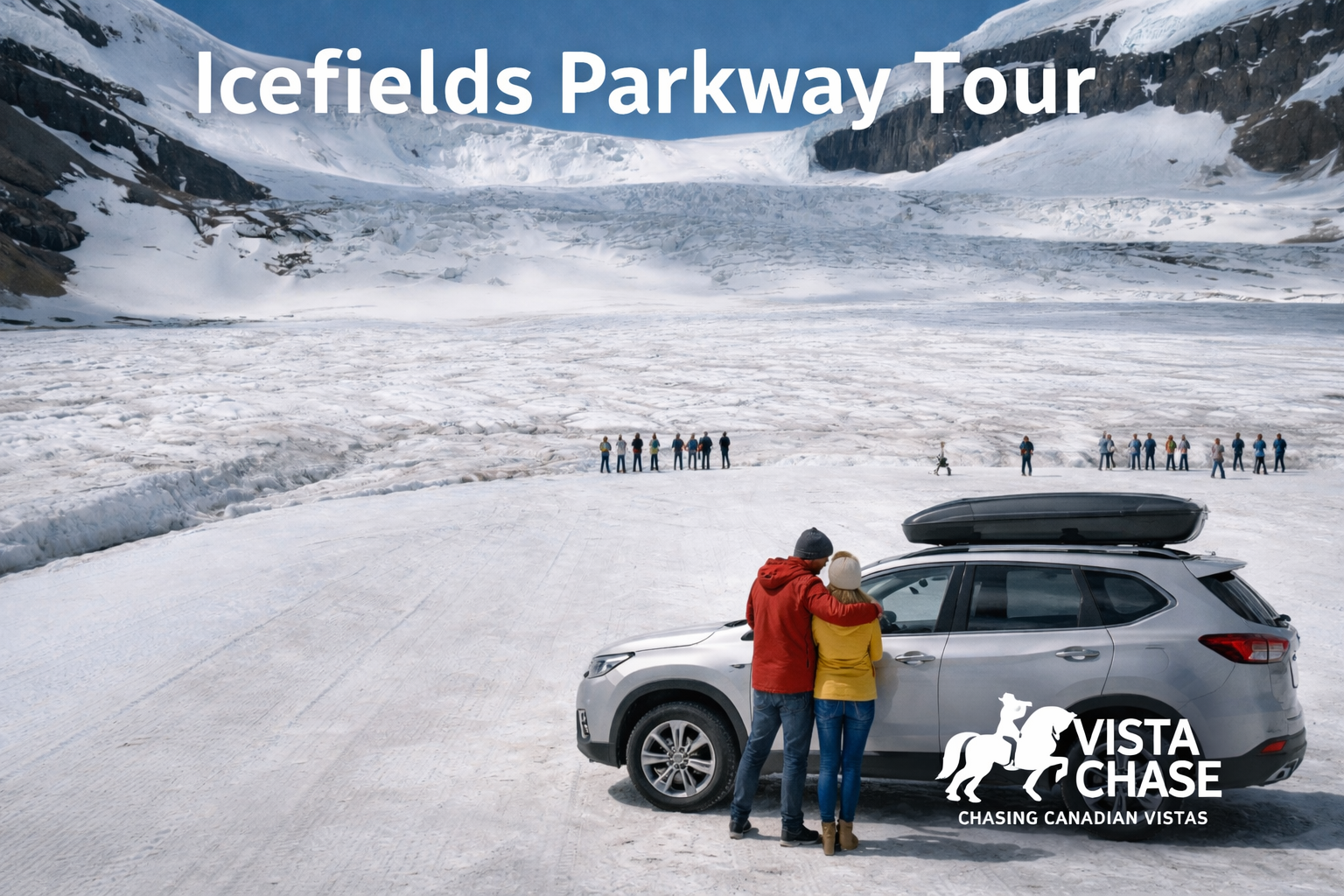
The Icefields Parkway (Highway 93) is widely regarded as one of the most spectacular drives on Earth. Stretching 232 kilometres (144 miles) through the heart of the Canadian Rockies, this iconic route connects Banff National Park to Jasper National Park, passing ancient glaciers, turquoise lakes, cascading waterfalls, and towering mountain peaks at every turn. Whether you are a first-time visitor or a returning explorer, knowing the best stops and viewpoints along the Icefields Parkway can be the difference between an ordinary road trip and a truly life-changing journey.
In this complete 2026 guide, we cover every major stop, hidden gem viewpoint, seasonal tips, and insider advice you need to plan the perfect Icefields Parkway tour. We also share how Vista Chase — a trusted Canadian Rockies tour operator — can help you experience this legendary highway without the stress of driving, parking, or navigating alone.
What Is the Icefields Parkway?
The Icefields Parkway, officially designated as Alberta Highway 93, runs from the town of Lake Louise in Banff National Park northward to the town of Jasper in Jasper National Park. It passes through two UNESCO World Heritage Sites and the Columbia Icefield, which is the largest icefield in the Rocky Mountains south of Alaska.
The highway was constructed during the Great Depression as a relief project and opened in 1940. Today, it is one of the most visited scenic drives in all of North America, attracting millions of travellers annually who come to witness its dramatic alpine scenery up close.
Driving the full length takes approximately three to four hours without stops, but most travellers — and virtually all guided tours — plan for a full day of seven to ten hours to fully appreciate every major attraction along the way.
Discover breathtaking landscapes, glacier-fed lakes, wildlife, and scenic drives with this complete guide to private tours in Jasper National Park. Explore the blog here: Jasper National Park Private Tours Guide.
Why Take a Guided Tour Instead of Driving Yourself?
Many travellers assume that renting a car and self-driving the Icefields Parkway is the most flexible option. While this can work for experienced road-trippers, there are significant reasons why a guided tour delivers a far superior experience.
Parking congestion at peak summer stops such as Peyto Lake, Athabasca Falls, and the Columbia Icefield is extreme. Lots fill before 8:00 AM on busy days, and you may spend more time circling for a parking space than actually enjoying the view. A professional guide drives while you relax, absorb the scenery, and arrive at each viewpoint directly.
Beyond logistics, a knowledgeable local guide brings the landscape to life. They share the geological history of the glaciers, point out wildlife such as bears, elk, bighorn sheep, and mountain goats that an untrained eye easily misses, and recommend the precise moment at each stop that delivers the best photographs.
Vista Chase offers both Private Tours and Shared Tours along the Icefields Parkway. Private tours give you full control over the pace and stops, while shared small-group tours are a budget-friendly way to experience the same incredible route with the social energy of fellow travellers.
Best Stops on the Icefields Parkway: North to South Itinerary
This guide follows the route from Lake Louise (south) to Jasper (north), which is the most common direction for day tours departing from Banff or Calgary. Each stop is described with what to see, how long to spend, and pro tips to maximize your visit.
Stop 1: Lake Louise — The Gateway to the Parkway
The Icefields Parkway officially begins at the junction near the village of Lake Louise, making this iconic turquoise lake the natural first stop on any southbound-to-north itinerary. Lake Louise is arguably the most photographed natural landmark in Canada, with the emerald-green water reflecting the Victoria Glacier and surrounding peaks in a scene that genuinely exceeds expectations even after you have seen it in thousands of photos.
The lakeshore walk takes approximately 30 to 45 minutes and is paved and accessible for all fitness levels. For a more dramatic perspective, the Big Beehive Trail or the Plain of Six Glaciers Trail offer elevated viewpoints that most visitors never reach. Early morning visits between 6:00 AM and 8:00 AM deliver the calmest water reflections and the fewest crowds.
For detailed planning advice, read the Vista Chase guide on Is Lake Louise Worth Visiting in 2026? Pros, Cons & Parking Tips.
Stop 2: Herbert Lake and Hector Lake Viewpoint
Just a few kilometres north of Lake Louise, Herbert Lake is a small but perfectly reflective body of water that mirrors the Bow Range. It is often overlooked by self-drivers who rush past, but it makes for a genuinely memorable photograph at sunrise when the light catches the peaks on the far shore.
Continuing north, the Hector Lake Viewpoint offers a sweeping aerial perspective of one of the largest lakes in Banff National Park. The lake is a deep blue-green and sits in an open glacial valley flanked by rugged, unnamed peaks. There is a well-positioned pullout with a safety railing that is ideal for photos. Budget five to ten minutes here.
Stop 3: Bow Lake — One of the Most Photographed Spots on the Parkway
Bow Lake is consistently ranked among the top five most beautiful lakes in the Canadian Rockies, and it is easy to understand why. The lake is fed directly by the Bow Glacier above, and its colour shifts from deep teal to vivid turquoise depending on the light and season. The historic Num-Ti-Jah Lodge sits on the north shore and has served guests since the 1920s, adding a layer of heritage charm to an already spectacular setting.
The short walk along the lakeshore trail (roughly 1 kilometre each way) brings you to the base of Bow Glacier Falls, a powerful cascade that thunders off the glacier above. This is one of the best moderate walks on the entire highway and is suitable for families with children. Plan for at least 45 to 60 minutes at this stop.
Stop 4: Peyto Lake Viewpoint — The Unmissable Icon
If you could visit only one viewpoint on the Icefields Parkway, most experienced guides and photographers would say Peyto Lake. From the elevated lookout above Bow Summit (the highest point on the Parkway at 2,088 metres), the lake below reveals itself as a vivid, almost impossibly bright turquoise shape — often described as resembling a howling wolf or a keyhole cut into the forest.
The colour comes from glacial rock flour suspended in the water, particles so fine they remain in suspension and scatter sunlight at the blue-green end of the spectrum. The effect is most intense in July and August when glacial melt is at its peak.
A new accessible boardwalk and viewing platform replaced the old trail in recent years, making the lookout reachable for most visitors. The walk from the parking area to the main platform is approximately 400 metres. For the elevated Bow Summit Lookout with even broader views, a one-kilometre trail leads further up the ridge. Arrive before 9:00 AM to avoid crowds; this stop fills rapidly from mid-morning onward.
Explore Wildife Viewing tours in Banff
Stop 5: Mistaya Canyon — A Hidden Geological Wonder
Mistaya Canyon is one of the most underrated stops on the Icefields Parkway and one that guided tours make a point of including. A short 500-metre trail through a forest of Engelmann spruce leads to a dramatic limestone gorge carved by the Mistaya River over thousands of years. The river has sculpted potholes, arches, and narrow channels into the rock, creating a natural sculpture gallery that rewards close inspection.
Most self-drivers miss this stop entirely because the parking area is small and easy to pass at highway speed. Guided tours treat it as a must-see, particularly for travellers with an interest in geology or photography. The canyon is at its most dramatic in late spring when snowmelt pushes the river to full power. Allow 20 to 30 minutes.
Stop 6: Saskatchewan River Crossing
Saskatchewan River Crossing (locally called "the Crossing") sits at the convergence of three major river valleys and is the only service stop between Lake Louise and the Columbia Icefield. It offers fuel, food, and basic accommodation. Strategically, it is a critical rest stop for self-drivers but it is also a genuinely beautiful location.
The wide, braided valley of the North Saskatchewan River stretches out before a backdrop of massive peaks including Mount Wilson and the Howse Peak massif. Wildlife sightings here — particularly elk and mule deer — are frequent, especially in early morning and evening hours. The flat valley floor also creates conditions for outstanding alpenglow photography when the peaks catch the last light of the day.
Stop 7: Weeping Wall
The Weeping Wall is a 100-metre-high limestone cliff face that seeps water continuously through the summer months, creating dozens of parallel cascades that run from top to bottom of the exposed rock face. The combined effect resembles a curtain of water draped across the mountain.
In winter, the Weeping Wall transforms into a celebrated ice climbing destination as the cascades freeze into enormous columns of ice. In summer, the wall is visible from the highway and from a small pullout on the east side of the road. It makes for a striking photograph, particularly in afternoon light when the entire face is illuminated.
Stop 8: Parker Ridge Trail — Walk Above the Treeline
Parker Ridge is one of the few stops on the Icefields Parkway that requires a moderately strenuous hike but rewards the effort with a perspective available nowhere else on the highway. The trail gains 250 metres of elevation over 2.4 kilometres (each way) through open alpine meadows and emerges at a high ridge with a direct, face-on view of the Saskatchewan Glacier — the longest glacier in the Columbia Icefield system.
Standing at Parker Ridge and looking south down the full length of the Saskatchewan Glacier is one of the most profound glacier experiences in the Canadian Rockies. The scale is immense and the silence at the ridge, broken only by wind, is extraordinary. Allow two to three hours for the full round trip. This trail is only snow-free from July through September and can be challenging in poor weather due to its exposed position.
Stop 9: Columbia Icefield and Athabasca Glacier — The Centrepiece
The Columbia Icefield is the largest accumulation of ice and snow in the Rocky Mountains south of Alaska, covering approximately 325 square kilometres. It feeds eight major glaciers, including the Athabasca Glacier, which flows directly toward the Icefields Parkway and is one of the most accessible glaciers in North America.
The Athabasca Glacier can be seen clearly from the Icefield Discovery Centre on the west side of the highway. Interpretive signs and historical photographs document the glacier's dramatic retreat over the past century — a sobering and visceral lesson in climate change. Markers along the moraine show where the glacier's edge stood in 1890, 1950, 1980, and more recent years, each one farther from the current ice margin than the last.
Visitors can walk to the toe of the glacier on a gravel trail (approximately two kilometres round trip from the parking area) or take a guided glacier walk organized through the Icefield Centre. Walking on the glacier surface requires a guide and appropriate footwear. The Columbia Icefield is the anchor stop of any Icefields Parkway tour and deserves a minimum of one to two hours.
Stop 10: Sunwapta Falls — Power and Beauty Combined
Sunwapta Falls is a two-part waterfall system where the Sunwapta River plunges through a narrow limestone canyon before widening into a broader lower falls. The upper falls, visible from a short paved path just minutes from the parking area, drop approximately 18 metres into a deep, bottle-green pool. The roar of the water and the fine mist that carries on the air make this one of the most physically immersive waterfall experiences on the Parkway.
The lower falls, reached by a short additional trail, are wider and more powerful though less dramatic in height. Together, the two falls form one of the most complete waterfall experiences in Jasper National Park. Allow 30 to 45 minutes and wear waterproof footwear near the lower falls viewing area.
Stop 11: Athabasca Falls — The Most Powerful Falls on the Parkway
Despite dropping only 23 metres — shorter than many other Canadian waterfalls — Athabasca Falls is the most powerful waterfall in the Canadian Rockies by volume, carrying more water than any other fall in the region. The sheer force of the Athabasca River funnelling through a narrow quartzite gorge creates a physical presence that is felt as much as seen: the ground vibrates, the air is thick with spray, and the sound is overwhelming even from the viewing platform above.
The site has an extensive network of paved paths, bridges, and viewpoints that allow visitors to observe the falls from multiple angles at varying distances. Early morning visits in June and July, when snowmelt is at maximum, deliver the most dramatic water volumes. Budget 30 to 45 minutes. Athabasca Falls marks the final major stop before reaching the town of Jasper and is included in virtually every full-day Icefields Parkway tour.
Hidden Viewpoints and Bonus Stops Worth Your Time
Beyond the main attractions, the Icefields Parkway has a number of lesser-known viewpoints and short detours that reward curious travellers who venture off the main itinerary.
Tangle Creek Falls
Located just north of the Columbia Icefield, Tangle Creek Falls is visible directly from the highway on the west side of the road. The multi-tiered cascade drops down an open rock face and is one of the only major waterfalls on the Parkway that can be photographed without leaving your vehicle, though a short roadside pullout makes a proper stop easy. The falls are particularly impressive in June and early July.
Beauty Creek
Beauty Creek is a short interpretive trail that leads to a series of small but intensely colourful waterfalls hidden in a limestone canyon. The trail is unmarked on many maps and consistently missed by self-drivers. The canyon walls are coated in golden lichen and the water runs in a deep blue-green that contrasts brilliantly with the surrounding rock. Allow 45 minutes for the trail.
Goats and Glaciers Lookout
Situated south of Sunwapta Falls, this elevated pullout offers an expansive view of the valley below with frequent sightings of mountain goats on the cliff faces. The combination of wildlife viewing and glacier backdrop makes this one of the most photographed informal stops on the northern half of the Parkway.
Best Time of Year to Drive the Icefields Parkway
The Icefields Parkway is open year-round but each season offers a dramatically different experience.
June and July
Peak wildflower season in the alpine meadows, maximum water volume in waterfalls and rivers, and the first full access to high-elevation trails such as Parker Ridge. Crowds are heavy but the scenery is at its most vibrant. Book any guided tour well in advance.
August
Glacier melt peaks in August, making lake colours most intense. Temperatures are warmest and all trails are fully accessible. This is the busiest month on the highway, and parking congestion at popular stops is at its worst — making a guided tour particularly valuable during this period.
September
|
Many experienced visitors consider September the single best month to drive the Icefields Parkway. Crowds thin significantly after Labour Day, larch trees in the sub-alpine zone turn gold (particularly spectacular around Lake Louise and Moraine Lake), and the air is clear and cool. The parkway typically remains fully open through October.
October and November
Snow arrives at higher elevations in October and can close mountain passes. The highway itself remains open, but several high-elevation trails close early. Wildlife activity increases as animals prepare for winter, making October excellent for wildlife sightings along the valley floors.
Winter (December to March)
Winter transforms the Icefields Parkway into a dramatic snow-and-ice landscape that most international visitors never experience. The Weeping Wall becomes a towering ice climbing structure, frozen lakes offer otherworldly reflections, and wildlife tracks in fresh snow tell stories across the entire valley. Road conditions require winter tires and caution, making a guided vehicle particularly appealing. For planning inspiration, the Vista Chase blog on What to Do in Banff in February: Winter Guide provides excellent winter advice.
Wildlife Watching Along the Icefields Parkway
The Icefields Parkway passes through some of the most intact wilderness in North America, and wildlife encounters are one of its greatest and most unpredictable gifts. The full list of species commonly encountered along the route includes grizzly bears, black bears, wolves, elk, moose, caribou (in the Jasper section), bighorn sheep, mountain goats, and golden eagles.
Wildlife sightings are most frequent in the early morning and late evening hours when animals move into open areas to feed. The wide valley floors around Saskatchewan River Crossing, the meadows near Sunwapta River, and the open slopes above Athabasca Falls are particularly productive wildlife zones. A guided tour ensures you benefit from a driver who can safely slow or stop when wildlife is spotted, and who knows from experience where animals are most likely to appear at different times of year.
What to Pack for Your Icefields Parkway Tour
Weather on the Icefields Parkway changes rapidly and dramatically. Even in July, temperatures at the Columbia Icefield can drop to near freezing with wind. A complete day packing list should include:
- Waterproof jacket and warm mid-layer regardless of the forecast
- Sturdy walking shoes or lightweight hiking boots with grip
- Sunscreen, sunglasses, and a hat (UV exposure at elevation is intense even on cool days)
- Reusable water bottle — staying hydrated at altitude is critical
- Camera with spare battery (cold temperatures drain batteries faster than expected)
- Snacks and lunch, as food options on the highway are limited to the Icefield Centre and Saskatchewan River Crossing
- Binoculars for wildlife spotting and glacier detail viewing
For a comprehensive packing guide, visit the Vista Chase resource on 32 Essential Things to Pack for Banff Weather: All-Season Guide (2026).
Planning a Multi-Day Canadian Rockies Itinerary
The Icefields Parkway is most rewarding when built into a broader multi-day Canadian Rockies itinerary that also includes Banff townsite, Moraine Lake, Lake Louise, and Jasper. Travellers who rush the highway in a single day often regret not allowing a full overnight stop in Jasper, which positions them to explore the northern end of the route — including Maligne Lake and Maligne Canyon — the following morning.
Vista Chase specializes in multi-day Canadian Rockies packages that combine the Icefields Parkway with Banff, Jasper, and Yoho National Parks. These packages include accommodation, expert guide services, and full logistics management so you can simply enjoy the experience. For itinerary ideas, read the Vista Chase guide on 5-Day Banff Itinerary: Banff, Yoho & Jasper Guide.
Vista Chase Multi-Day Tour Packages are especially popular with families and couples who want maximum efficiency and minimum stress across a full week in the Rockies.
Icefields Parkway Tour vs Self-Drive: Which Is Right for You?
Both options have merit and the right choice depends on your travel priorities. Self-driving offers maximum schedule flexibility and the ability to stop wherever and whenever you choose. If you are an experienced Canadian mountain driver comfortable with narrow mountain highways, wildlife on the road, and the possibility of weather-related delays, a self-drive can be deeply satisfying.
However, for first-time visitors, international travellers unfamiliar with Canadian road conditions, groups who want to share the experience rather than navigate, or anyone who simply wants to arrive at each viewpoint without the cognitive load of driving a technical mountain highway, a guided tour is the clear winner.
For a deeper comparison of tour options in the Banff area, the Vista Chase article on Banff Day Tours vs Multi-Day Tours: Which is Better? covers the key decision factors in detail.
Those considering a shared group experience will find useful context in the Vista Chase guide on Banff Private Tours vs Group Tours: Which Is Worth It?.
Practical Information for Your Icefields Parkway Tour
Entry Fees and Parks Pass
Both Banff and Jasper National Parks require a valid Parks Canada pass. A Discovery Pass provides unlimited access to all Parks Canada sites for one year and is excellent value for travellers spending more than three days in the national parks. Passes can be purchased online at the Parks Canada website or at park gates.
Driving Distance and Time
The Icefields Parkway covers 232 kilometres between Lake Louise and Jasper. Allow a minimum of seven to nine hours for a proper tour with stops. Tours departing from Banff add approximately 60 kilometres each way for a full day of roughly ten to twelve hours.
Speed Limits and Wildlife Safety
The speed limit on the Icefields Parkway is 90 km/h but reduces to 60 km/h in designated wildlife zones. Never brake suddenly or pull over on the highway when a wildlife sighting occurs. Use designated pullouts and keep a minimum distance of 30 metres from bears and 100 metres from wolves. Your guided driver handles all of this automatically.
Cell Service and Navigation
Cell service is unreliable for most of the Icefields Parkway. Download offline maps before departure if self-driving. Guided tour vehicles are equipped with satellite communication and emergency systems.
Gas and Fuel
The only fuel stop between Lake Louise and Jasper is at Saskatchewan River Crossing, approximately 77 kilometres north of Lake Louise. Always fill your tank in Lake Louise or Banff before beginning the drive.
Why Book Your Icefields Parkway Tour with Vista Chase?
Vista Chase has been guiding travellers through the Canadian Rockies for years, building a reputation built on local expertise, personalized service, and a genuine passion for sharing one of the world's great landscapes with visitors from around the world.
Our guides are not simply drivers — they are storytellers, naturalists, and photographers who know every bend of the Icefields Parkway and can read the light, weather, and wildlife patterns to deliver the experience that matches exactly what you came here to find.
- Private Tours — Your vehicle, your pace, your itinerary
- Shared Tours — Small groups, maximum adventure, great value
- Multi-Day Packages — Full Canadian Rockies experiences over several days
- Shuttles — Direct, guaranteed access transport to key attractions
Return to the Vista Chase homepage to explore all available tours, read recent reviews, and book your Icefields Parkway experience with confidence.
Frequently Asked Questions About the Icefields Parkway
How long does the Icefields Parkway tour take?
A full tour of the Icefields Parkway from Banff or Lake Louise to Jasper and back typically takes nine to twelve hours including all major stops. Tours departing from Jasper and returning the same direction run seven to nine hours.
Is the Icefields Parkway worth it?
Without question. The Icefields Parkway is consistently ranked among the top scenic drives in the world by National Geographic, Lonely Planet, and Condé Nast Traveller. The combination of glaciers, turquoise lakes, powerful waterfalls, abundant wildlife, and near-total wilderness makes it unique on Earth.
What is the best month to drive the Icefields Parkway?
June through September delivers the best overall conditions. September is the preferred month for experienced visitors due to smaller crowds, larch foliage, and excellent wildlife activity. July and August offer peak lake colours but maximum crowds.
Can I do the Icefields Parkway in one day?
Yes, a full day is sufficient to cover all major stops in one direction between Lake Louise/Banff and Jasper. Attempting to drive the full route and return the same day leaves very little time at each stop and is not recommended for first-time visitors.
Are there good hotels near the Icefields Parkway?
The main accommodation options near the Parkway are in Banff townsite (south end), Lake Louise village, and Jasper townsite (north end). The Num-Ti-Jah Lodge at Bow Lake and the Glacier View Lodge at the Columbia Icefield offer the only accommodation directly on the highway. For luxury accommodation guidance, the Vista Chase review of Best Fairmont Hotel in Alberta (2026): Banff vs Louise is a useful resource.
What wildlife can I see on the Icefields Parkway?
The Parkway is one of the most reliable places in North America to observe grizzly bears, black bears, elk, moose, bighorn sheep, mountain goats, and wolves in their natural habitat. Wildlife sightings are most frequent in early morning and late evening in open valley floors and avalanche slopes.
Final Thoughts: Make the Icefields Parkway the Drive of a Lifetime
The Icefields Parkway is not just a road. It is a corridor through one of the last truly wild mountain landscapes on the planet, a place where glaciers that have existed for thousands of years descend toward a highway built less than a century ago, where wildlife outnumbers people for hundreds of kilometres, and where every turn in the road reveals a new scene that belongs on a postcard.
Experiencing this highway with an expert guide who knows its rhythms, secrets, and best moments transforms what could be an ordinary drive into a deeply personal encounter with the natural world. Vista Chase exists to make that encounter as profound and as effortless as possible.
Ready to begin planning? Visit Vista Chase to explore all tour options, or contact our team directly to build a custom Icefields Parkway experience designed around exactly what you want to see and how you want to see it. Your Rocky Mountain adventure starts here.